Concept
The Matchbox Originals form a very collectible range. I collect these myself and always wanted to write a more in depth article about the history of these models.In 1987 Nick Austin, marketing director of Matchbox Toys, made a proposal that on the face of it was a stroke of genius. To celebrate the alleged 40th anniversary of Matchbox, he proposed the production of a three-piece limited edition gift set that would feature the first three miniature Matchbox models made. The idea had a lot going for it, not the least for the following reasons:
- It would enable the company to effectively celebrate its 40 years while at the same time prove the strength of its collector base in terms of offering retrospective packaging of its products for the first time.
- It would also be a good way to reinforce the heritage of the company with the toy trade while enabling them to gauge whether there was sufficient interest in the collector fraternity to extend the concept of reproducing Yesteryear products.
- Most importantly, a premium price could be charged for essentially a very inexpensive item.
Within a few weeks the board had accepted the proposal and a strategy was formulated, based on the assumption that 100,000 sets would be made and sold. All of the Matchbox markets would announce the pack at their respective trade toy fairs in early 1988. It had also been agreed that the styling of the models "should be similar to the originals, i.e. relativly crude".
The Research & Development department was briefed to provide mock-ups. The team leader sourced several examples of each of the three models and these were broken up to see how they had been made in 1953. The original models did not exist but the budget had at least allowed for completely new tooling. In fact, because the models were relativly simple, the eventual tooling cost stayed under USD 20,000 per model, about one third of the normal cost for a miniature.
Gerry Tekerian, a senior marketing manager, suggested that other original miniatures be considered. Especially in the light of comments made by the managing director of Matchbox Toys Italy, who had written that it was unfortunate that the original Matchbox models were actually reativly boring subjects! The number of models to be in the set was increased to five, based on originals from the 1950s. The retail price was set at GBP 14.95 per set and after all the markets had placed their orders, the revised total production run was marked at 75,000, with 35,000 going to the UK; 7,000 to Germany; 8,000 for the international market, including France and South Africa; 15,000 to the USA and 10,000 to Australia.
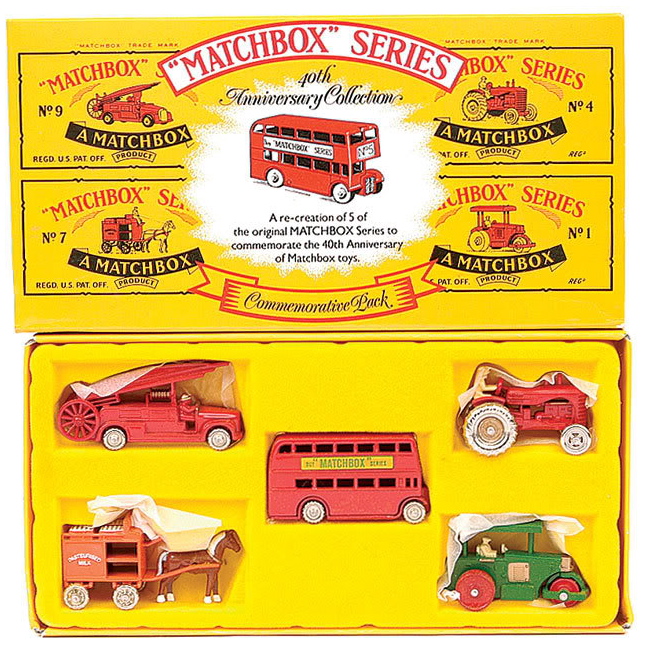
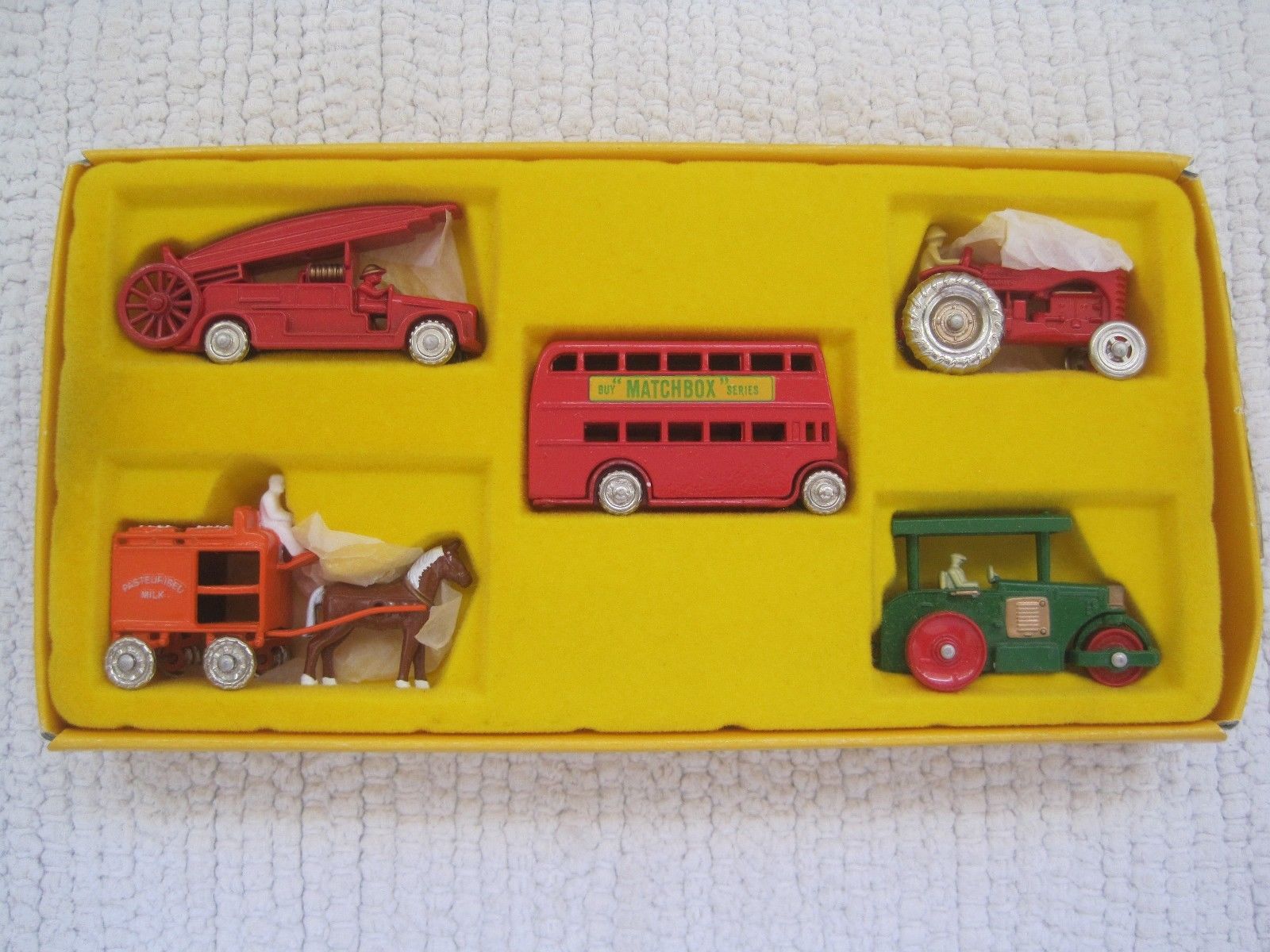
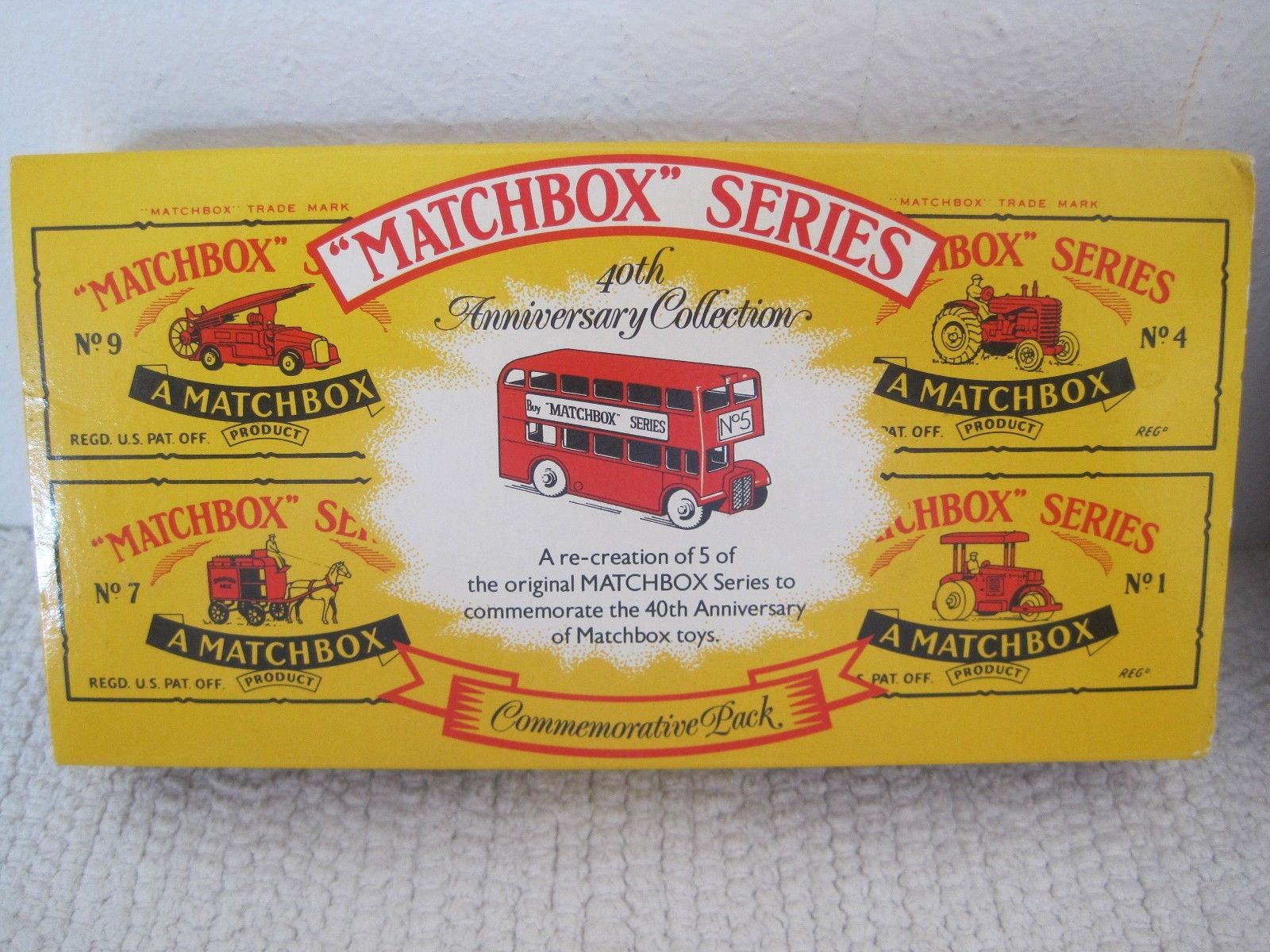
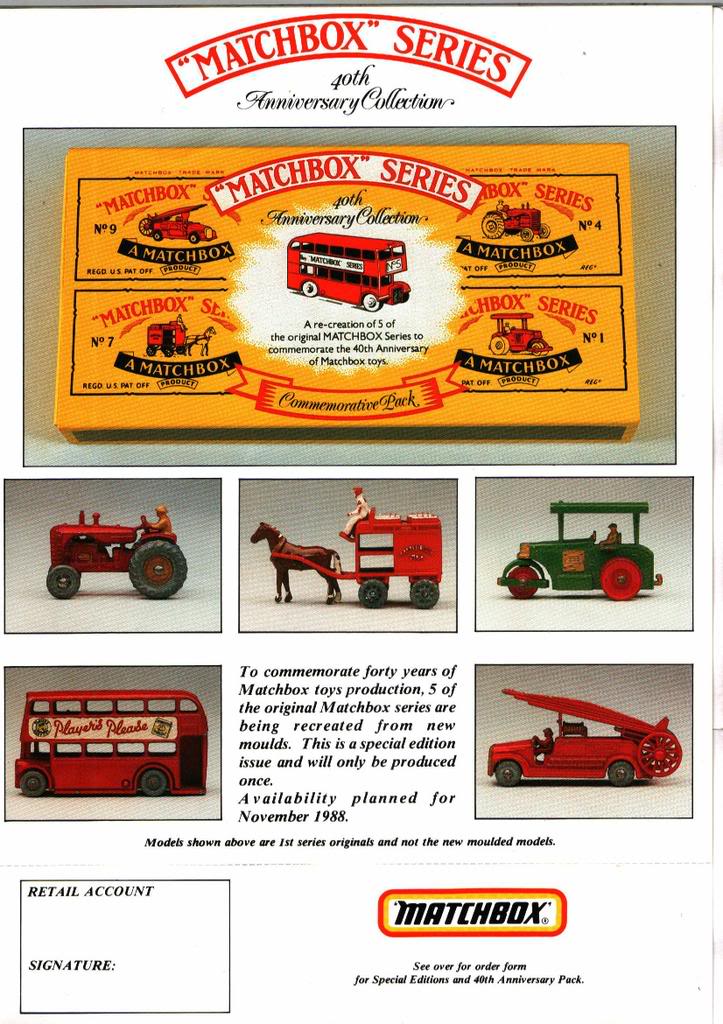
The set of painted models duly went on sale in November 1987. Using their original "Matchbox" Series numbers the five models were:
- MX-101 No.7 Horse-drawn Milk Float -- orange
- MX-102 No.5 London Bus -- "Buy Matchbox Series"
- MX-103 No.4 Massey Harris Tractor -- red
- MX-104 No.1 Aveling Barford Road Roller -- green
- MX-105 No.9 Dennis F.2 Fire Engine -- red with red escape wheels
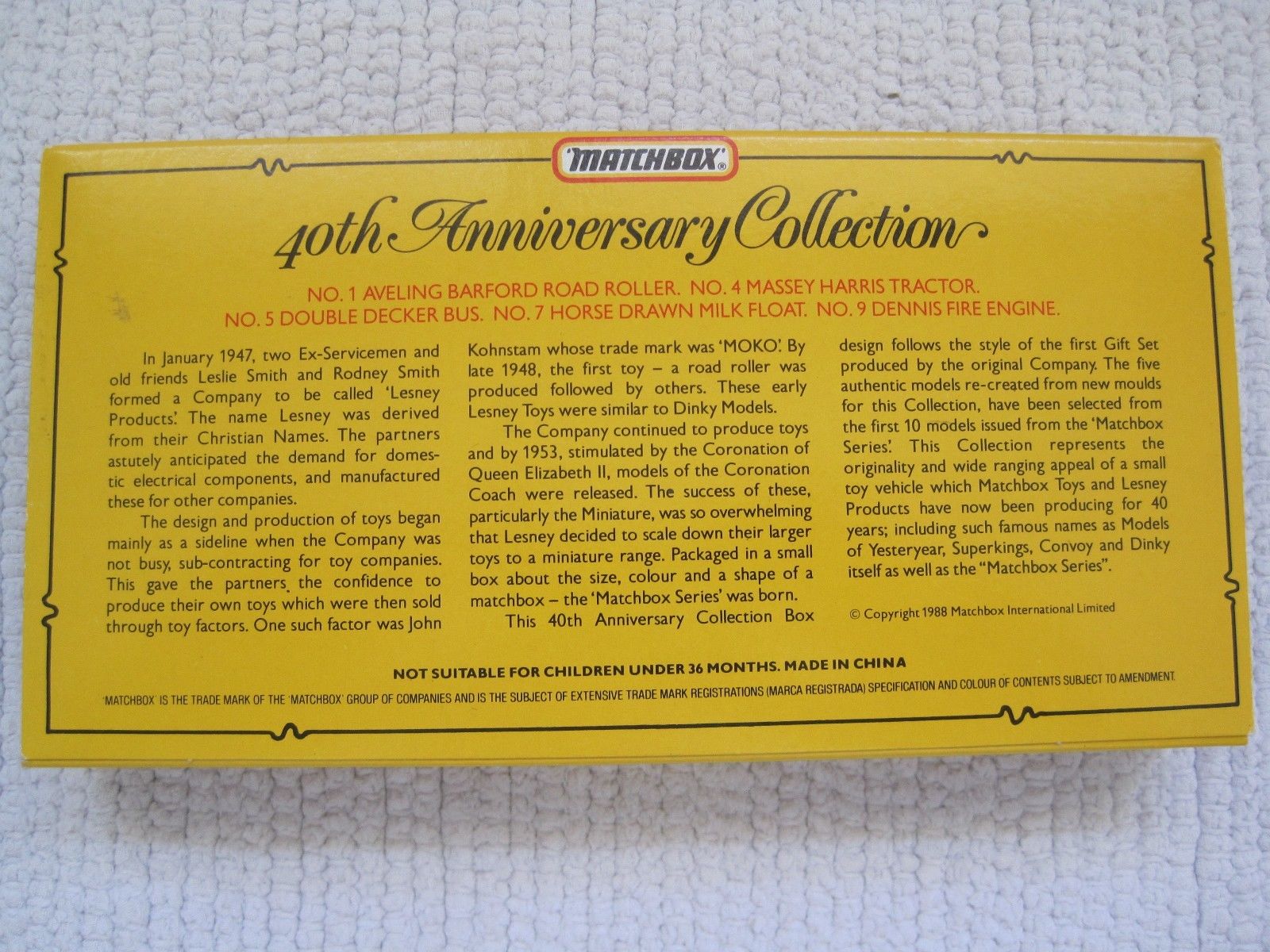
The box for the set was actually made with English text and German text.
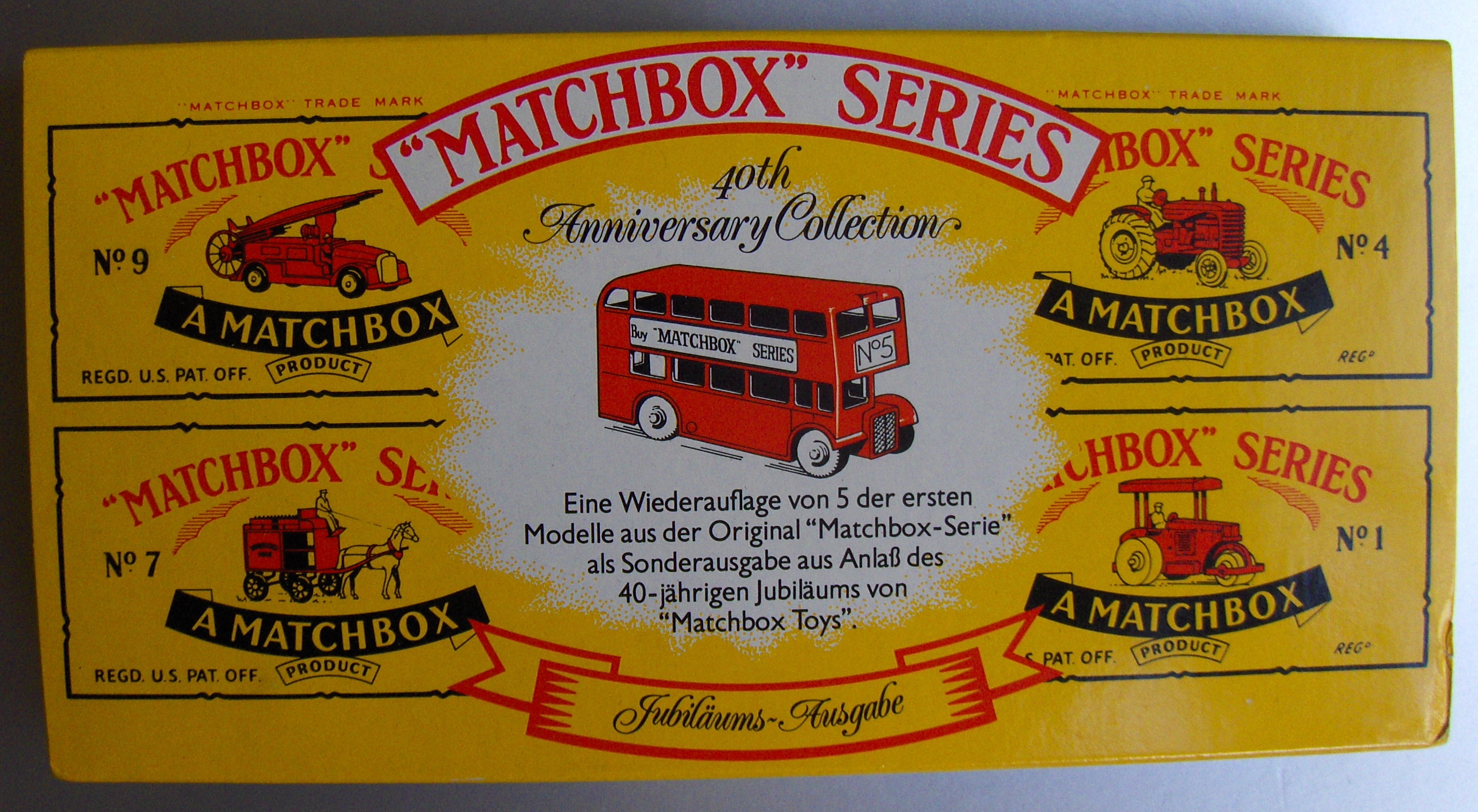
The barcode on the English ones end at 41 while the barcode on German front text boxes end at 42. Preproduction examples of the box with French tect exist but where never futher developed. Interesting of note also are the preproductions sets made with models being gold plated. One of these sets is pictured on page 73 of the small Charlie Mack book published by Schiffer (Universal Matchboxs Toys). It is also featured in the Bruce and Diana Stoneback Matchbox Toys book.
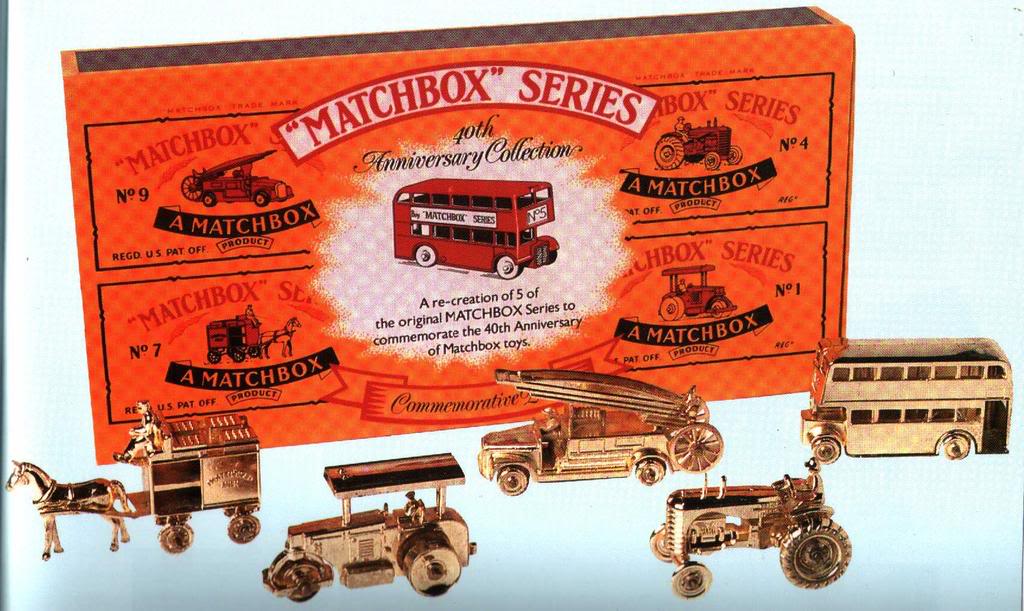
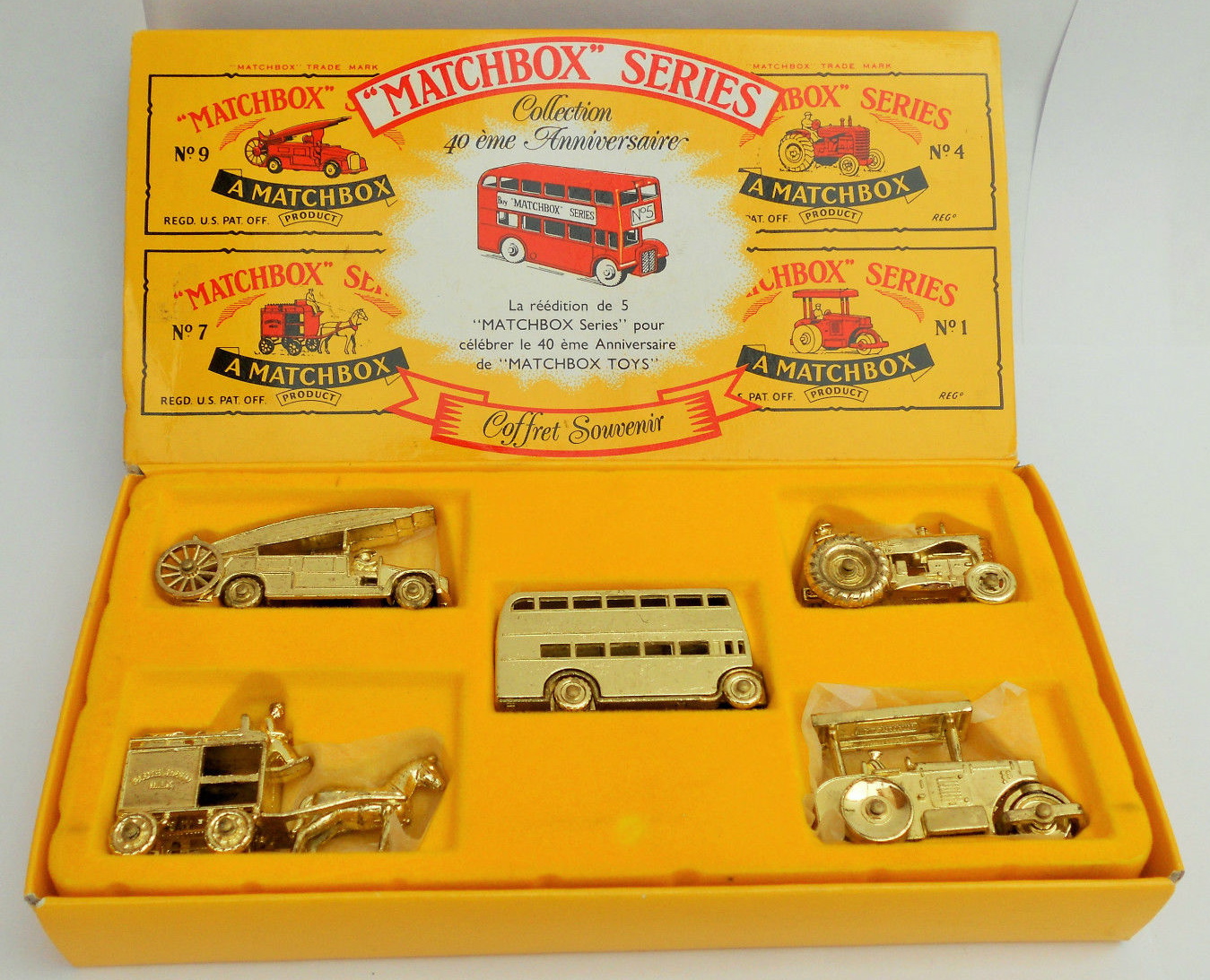
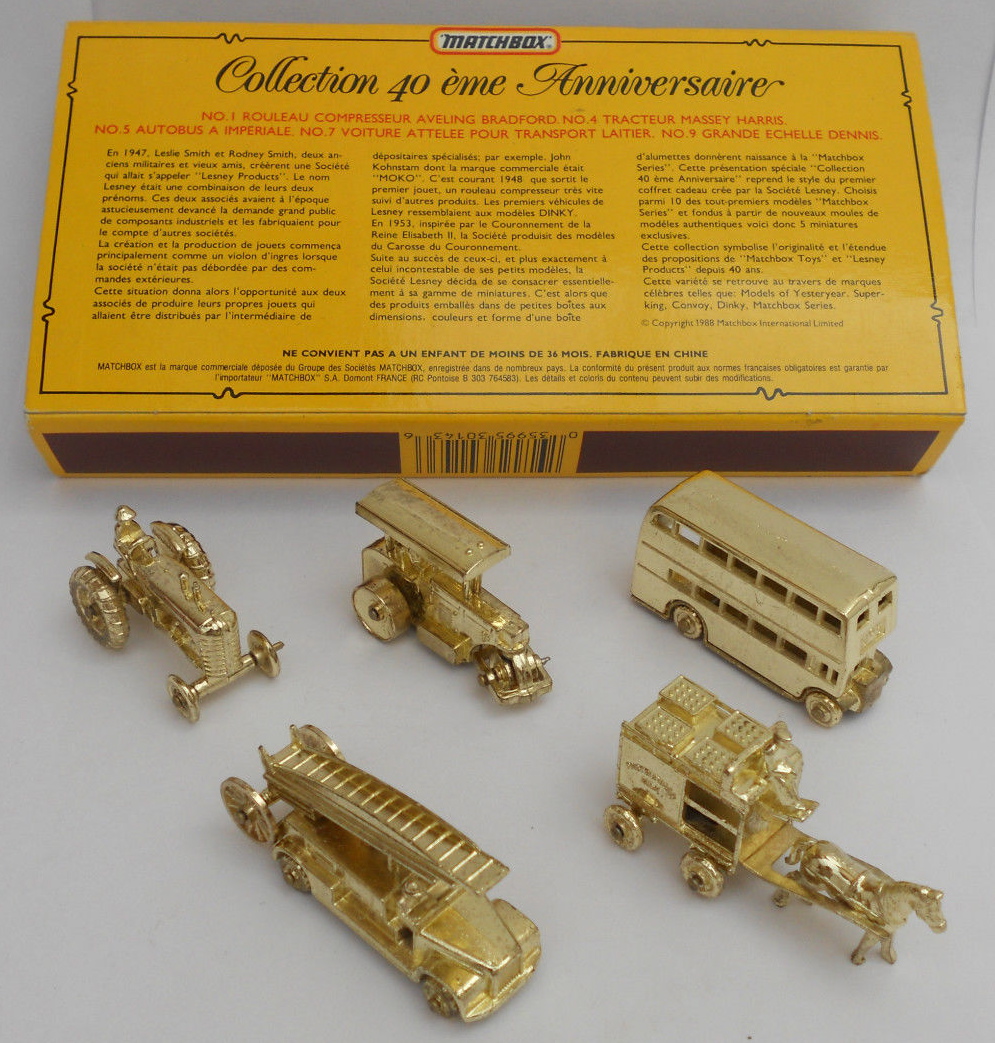
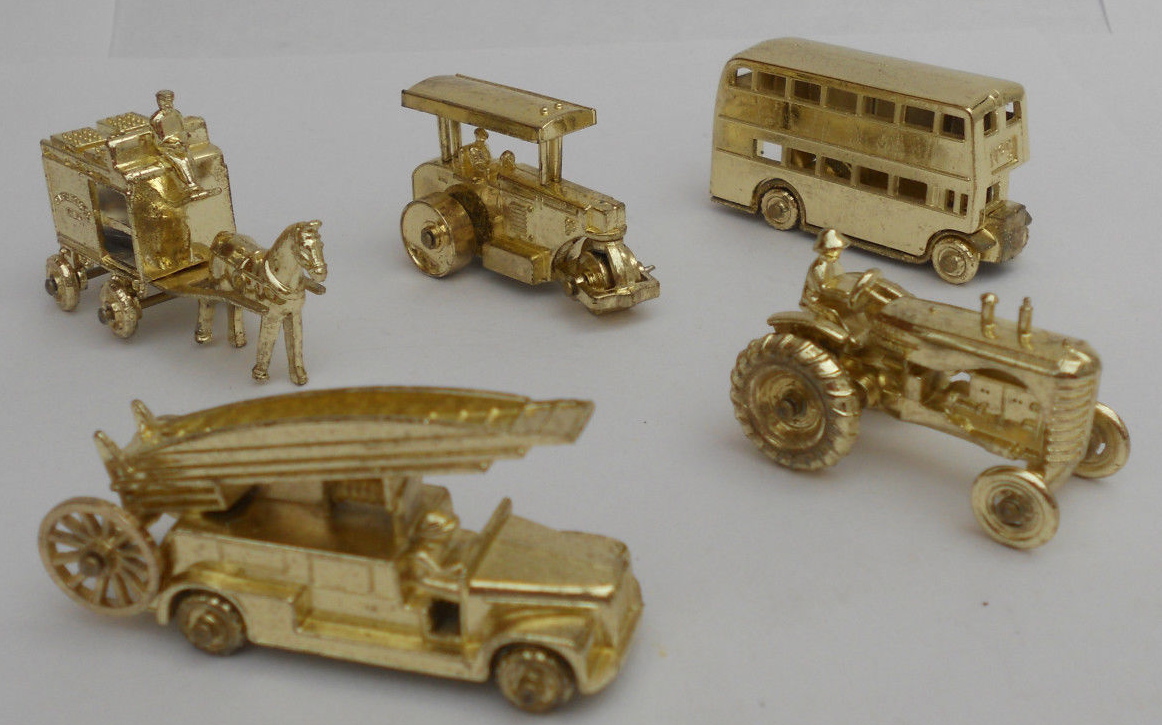
July 10th 2007, such a set was auctioned at Vectis. It fetched GBP 180 (without commission).
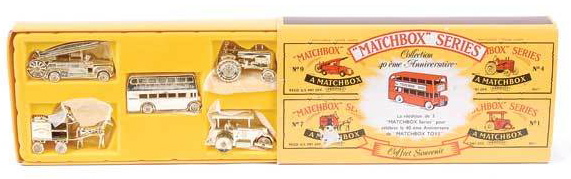
(note the French spelling on the box.)
Subsequent Sets
In 1991 these first five models were released but as single pieces in very good reproduction boxes that accuratly reflected 50s packaging. Three of the models were now recoloured.- dark blue for the Road Roller
- green for the Tractor
- pale blue for the Milk Float
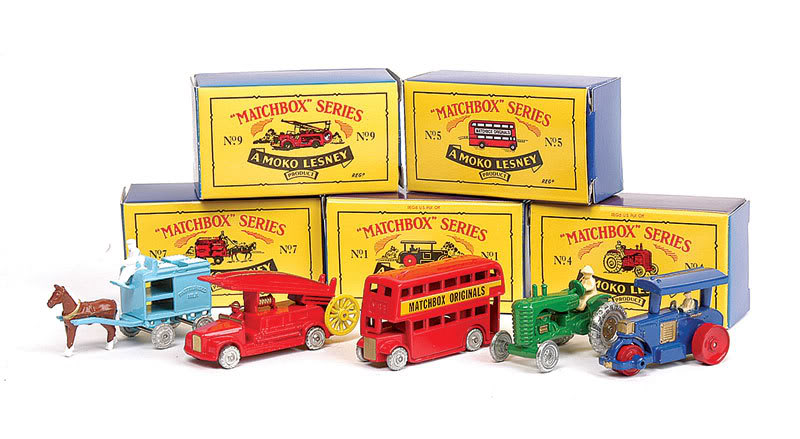
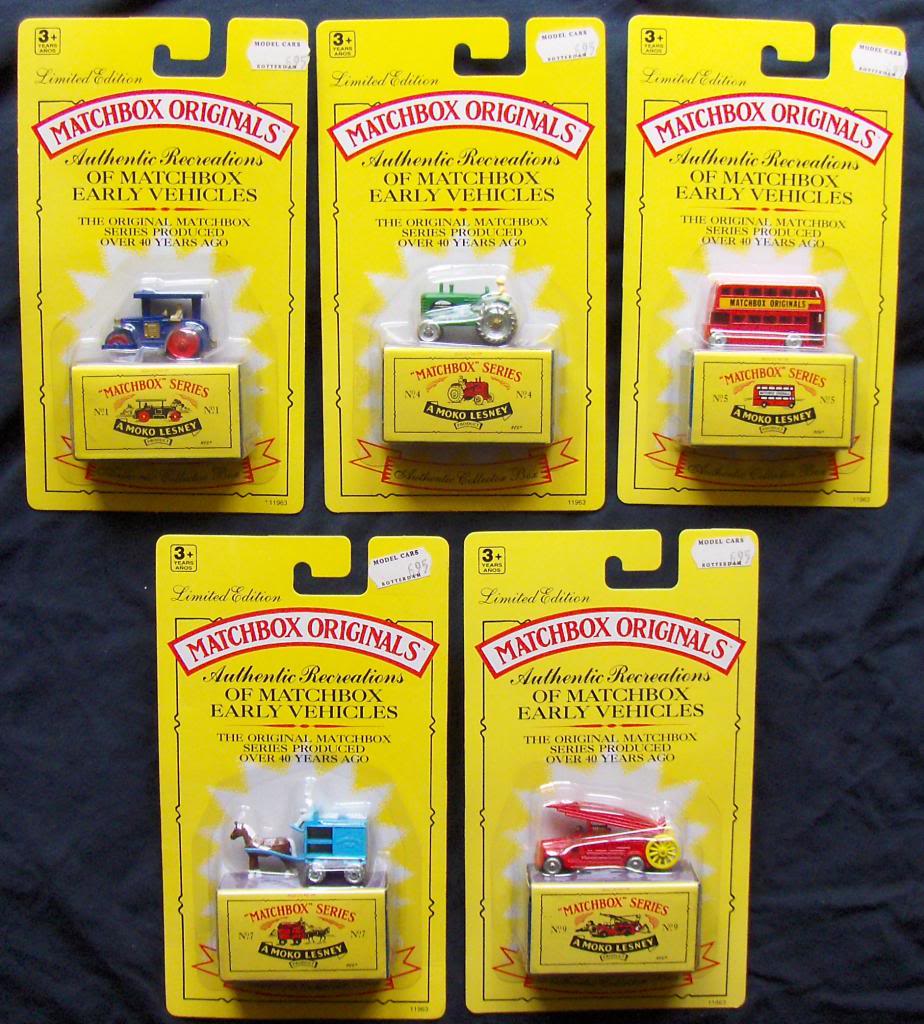
True to the original originals, there were variations to be found; for example, double or single canopy supports on the Road Roller can be seen clearly here in one of Christian's pictures.
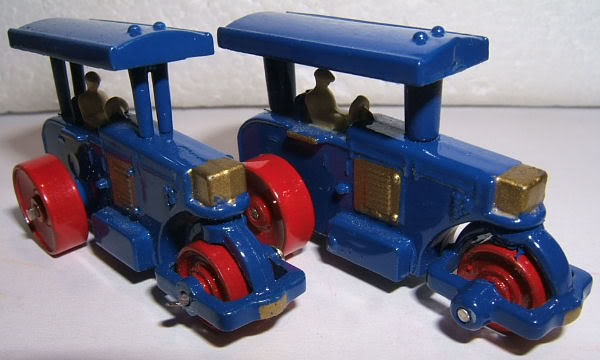
The retail price of Series I was GBP 1.99 each.
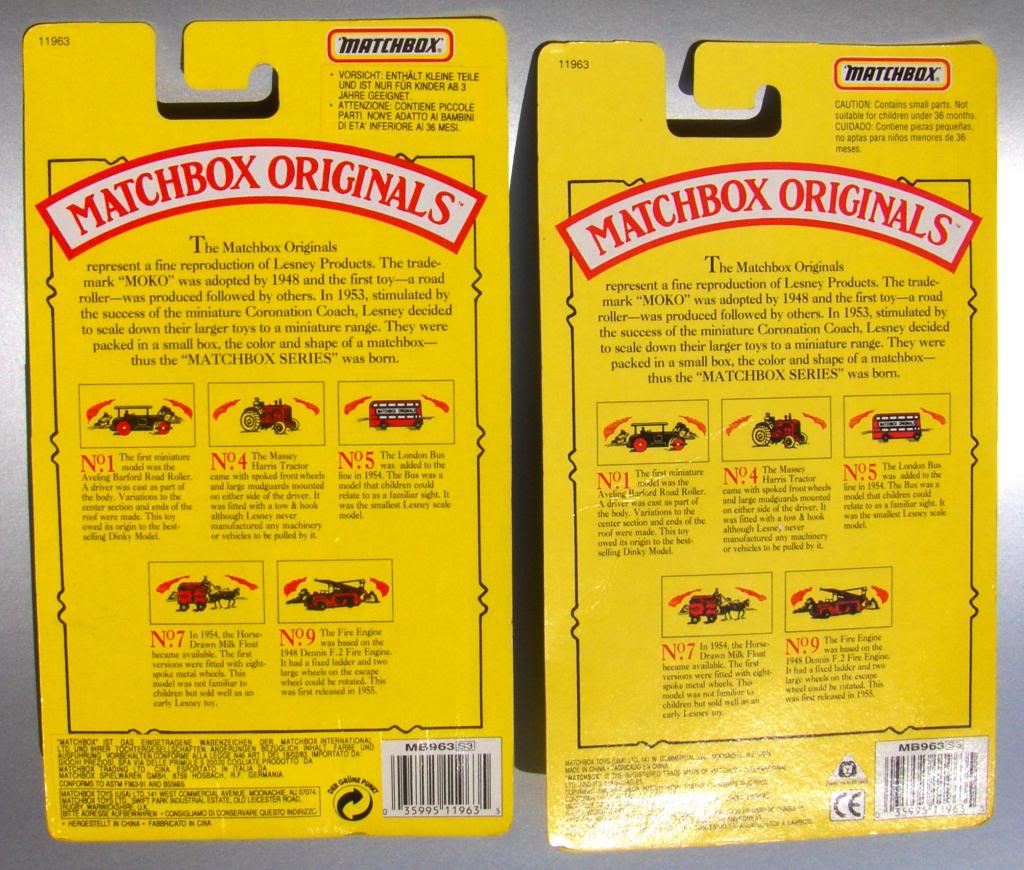
This first set of single models with the pale blue Milk Float and dark blue Road Roller from 1991 were normally available in large blisters where the models was standing on top of its repro box. However, in Germany the models were sold without the blisters, just in the repro boxes. The repro boxes are different as there is a barcode on the right end flap, a 3+ logo on front of the box, and all the trademark and warning information is on the left end flap and underside of the box.
This is, of course, because it could not be printed on the blistercard. The bus on this German box shows the "Players Please" advertisement (yellow label) while my English boxes show buses with the white Matchbox Originals labels.
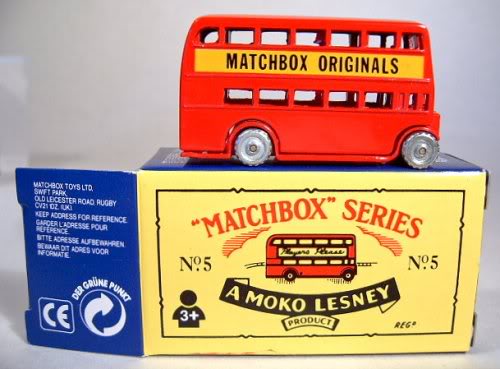
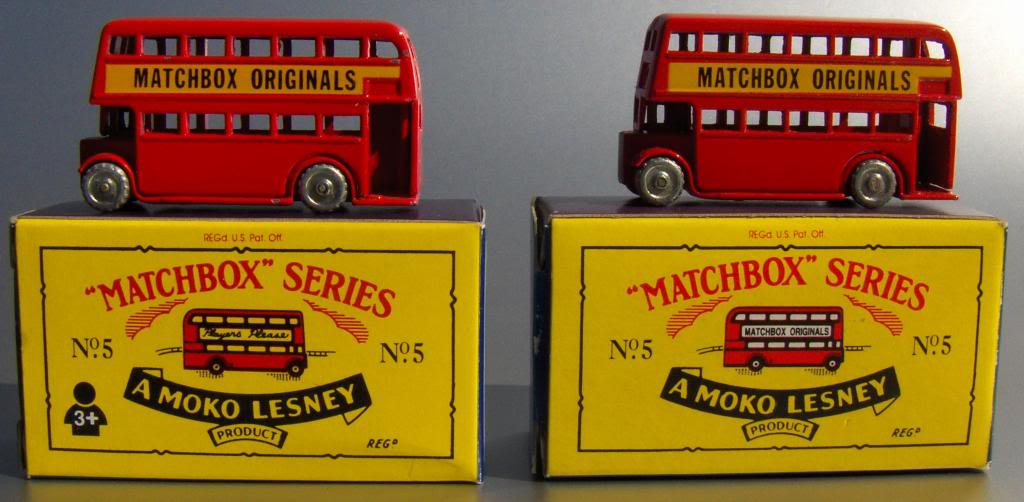
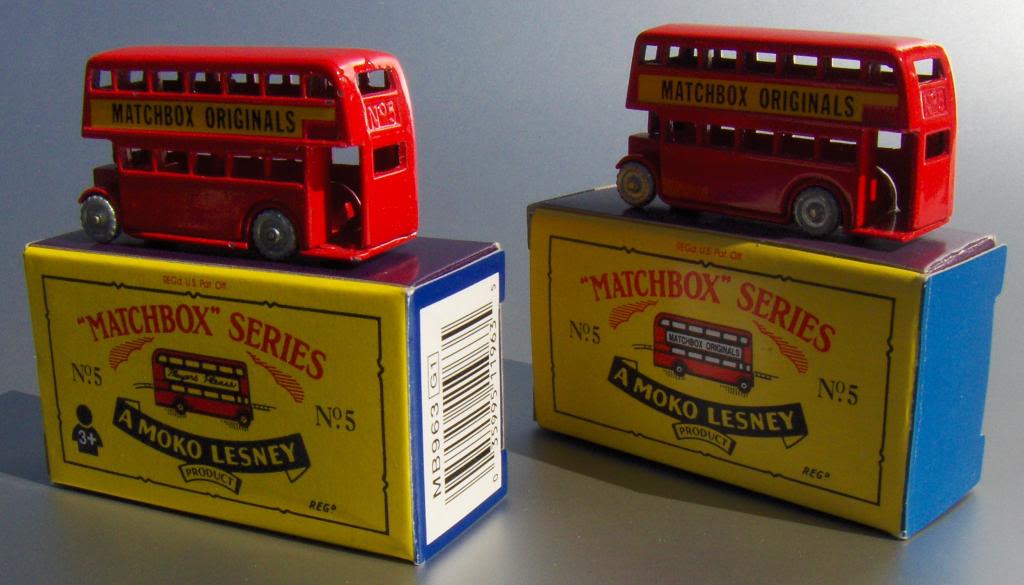
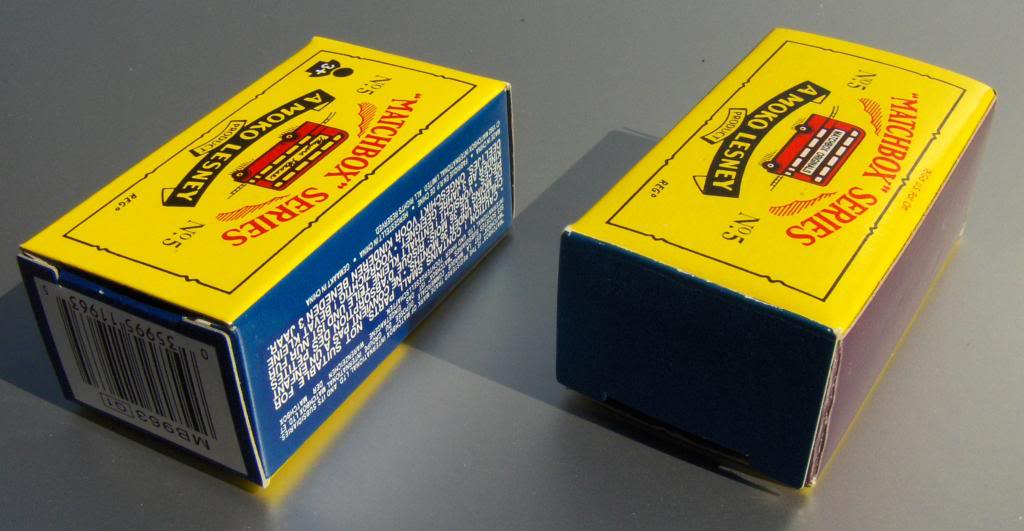
The models themselves always shows the yellow "Matchbox Originals" labels.
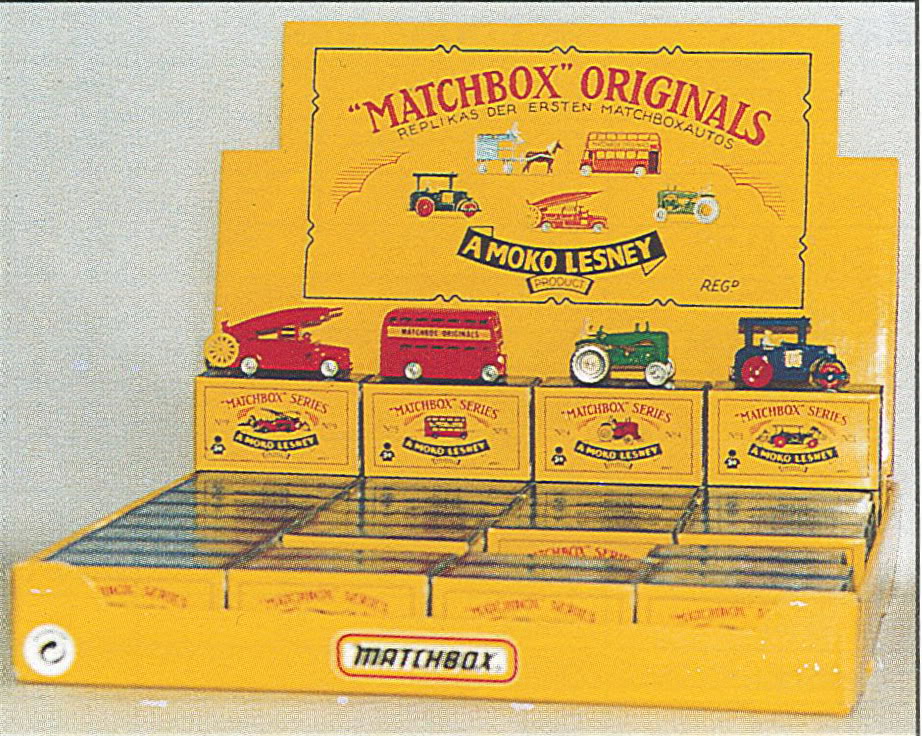
As these models were sold in Germany without their blisters they needed a shop display.
The retailer got a box of 36 models. The top of this box can be put backwards and erect. It says: "Matchbox Originals Replikas der ersten Matchbox autos" which means: "Replicas of the first Matchbox cars". It is a very clever item, made from yellow coloured cardboard. I only saw it for sale twice after I got my own example, so this shop display is realy difficult to find. Most were probably thrown away.
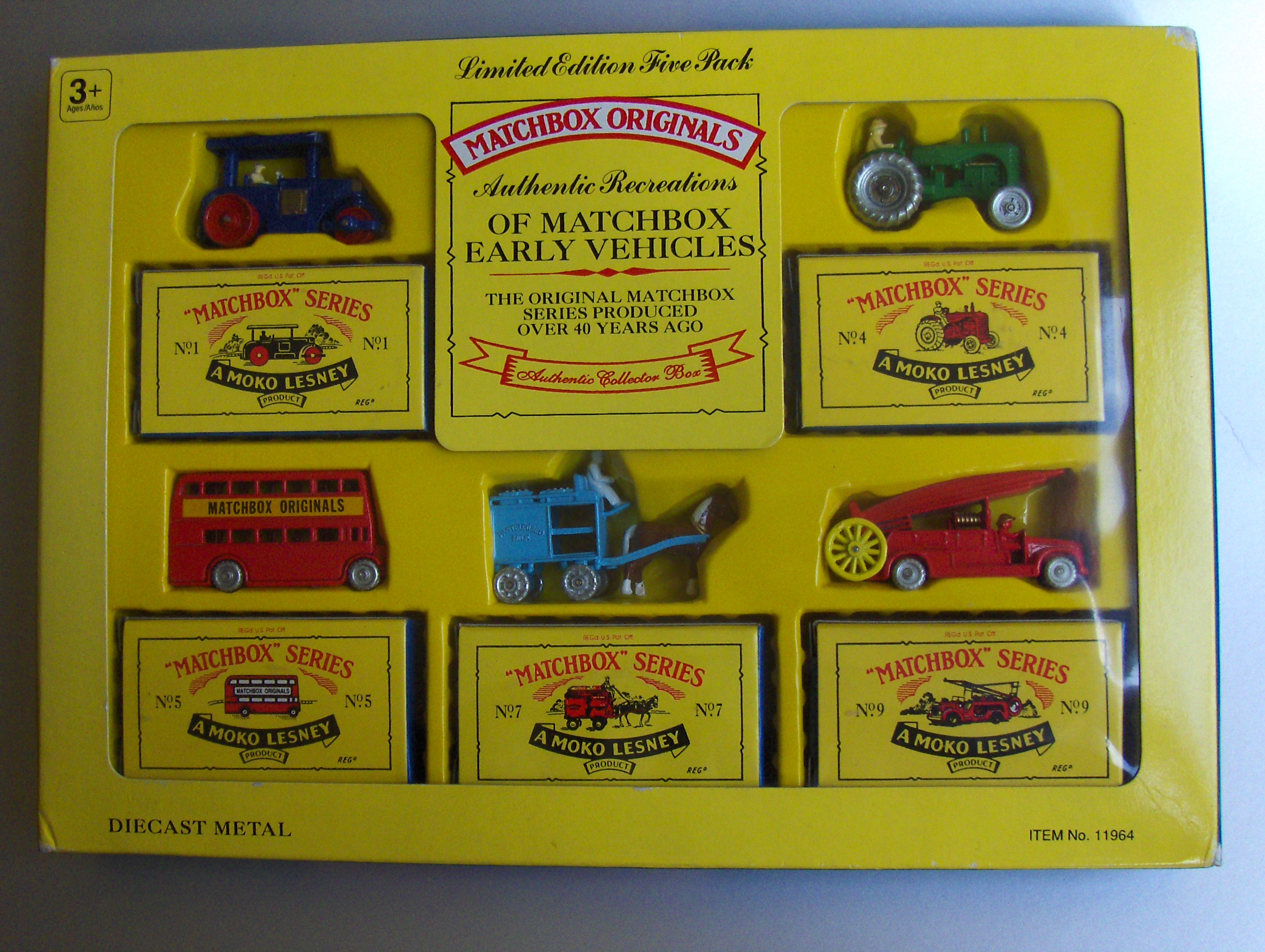
The same set of single models were repacked in a set in 1992.
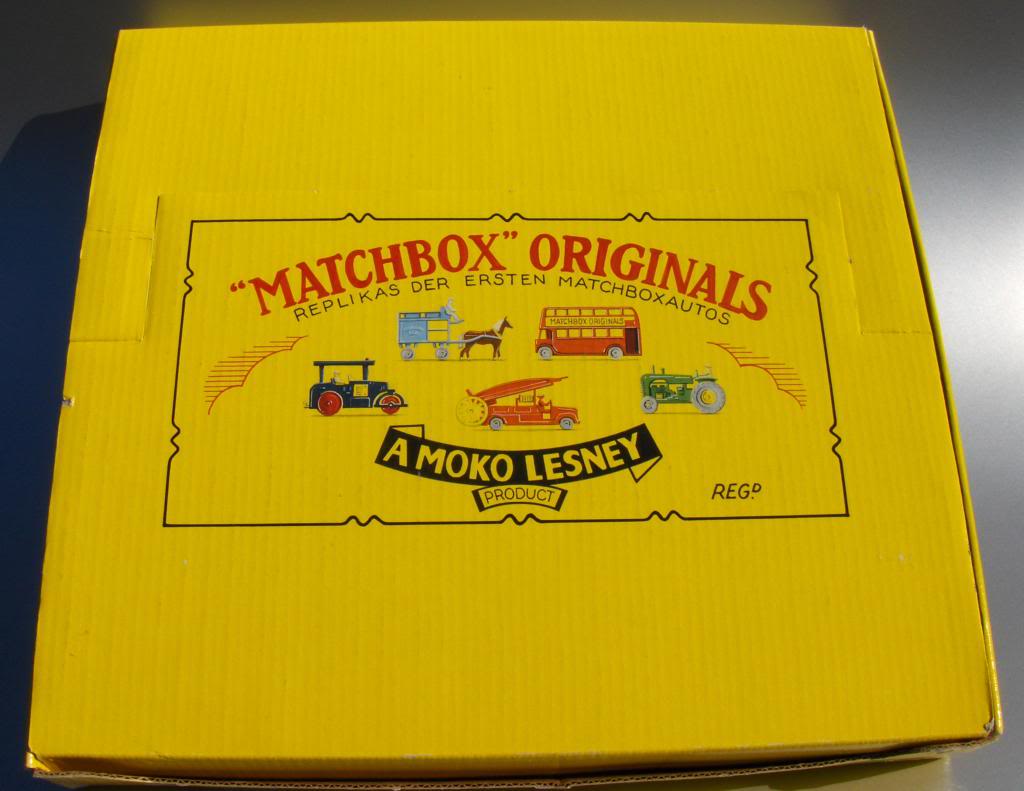
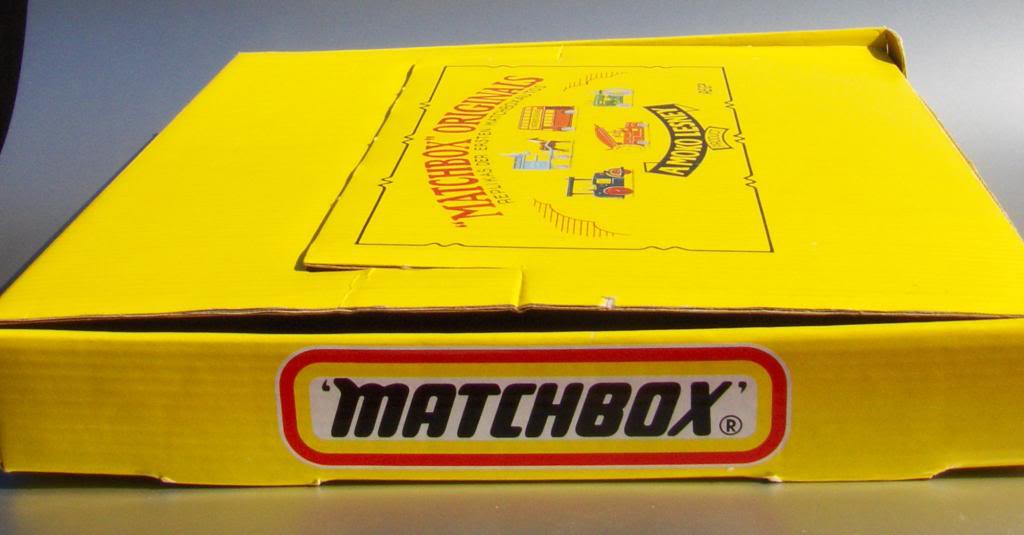
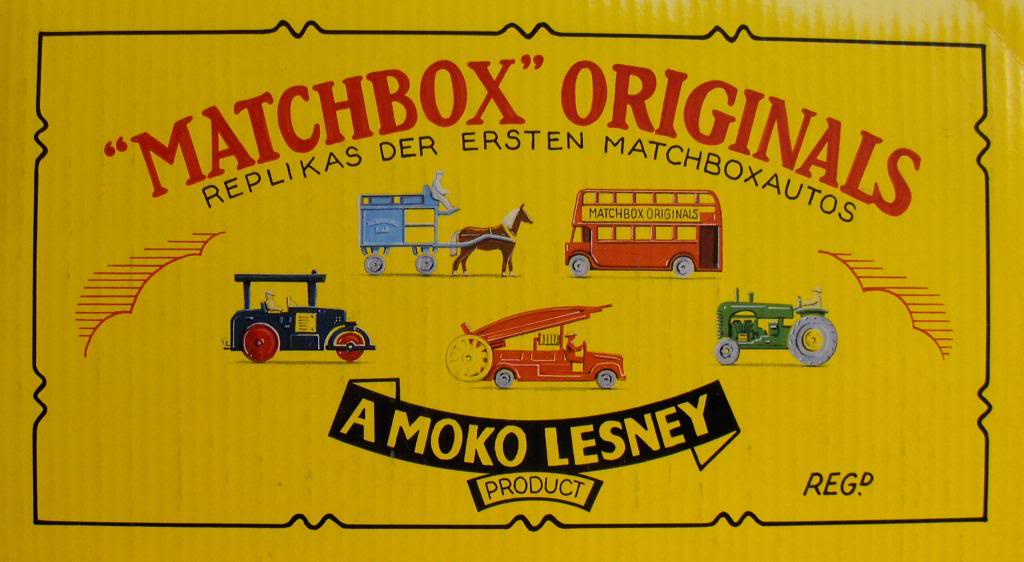
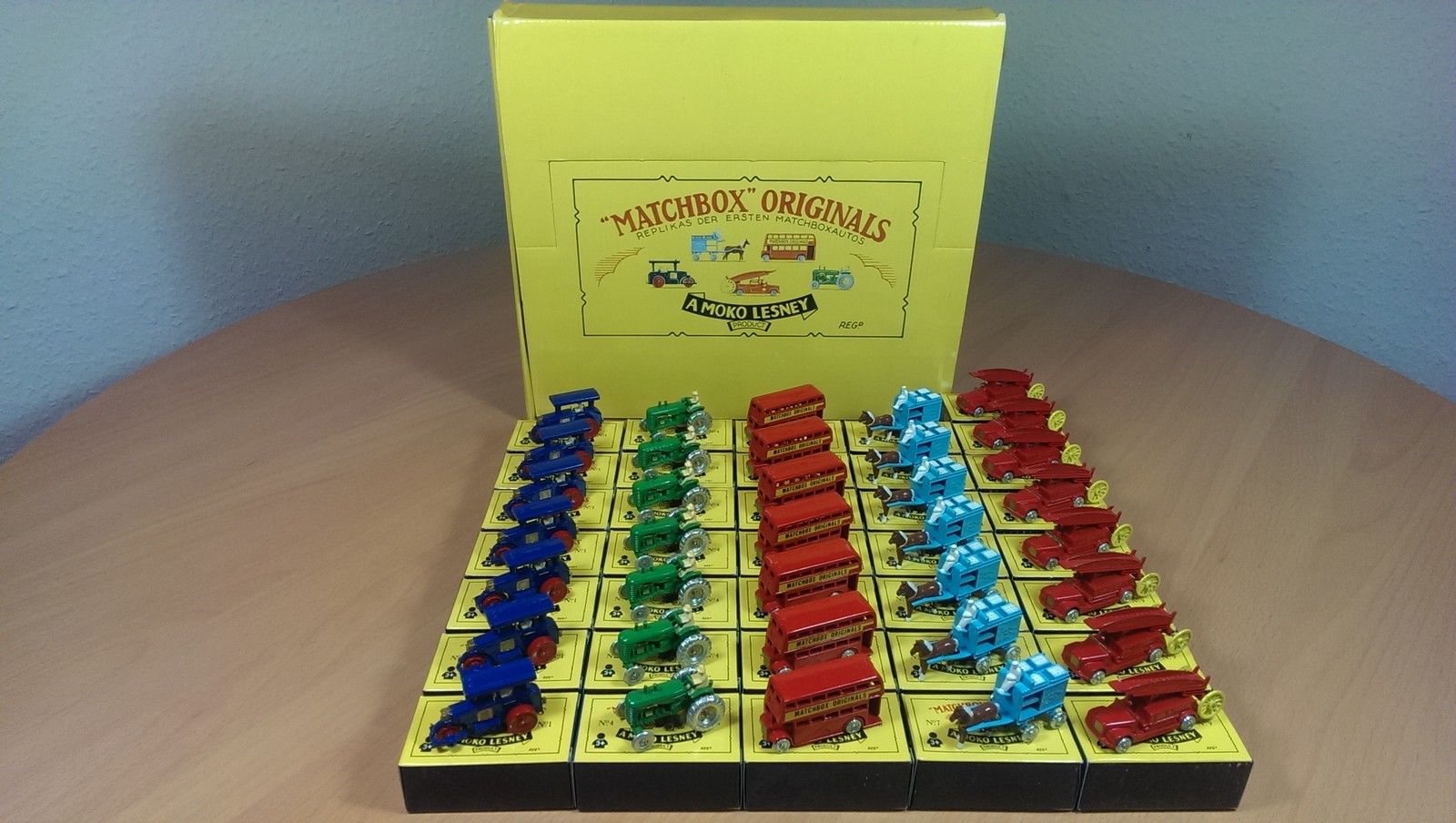
Described as item no. 11964 on the box, it's a very nice box and by having a window in the front it clearly shows all five models standing on their reproduction boxes. This should not be a difficult set to find.
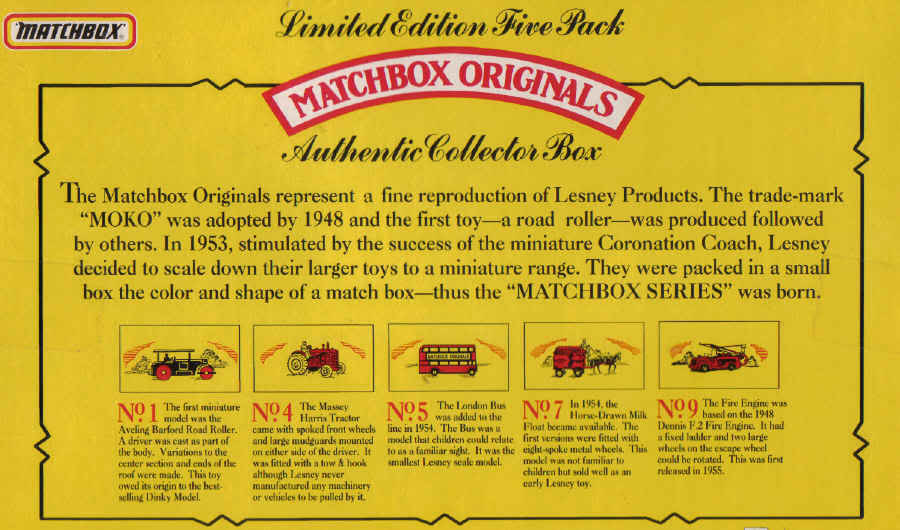
For the American market the five models were repacked in plastic baggies and then put in obnoxious yellow and red checker board box with Matchbox logo and the text, "The Original Collectibles."
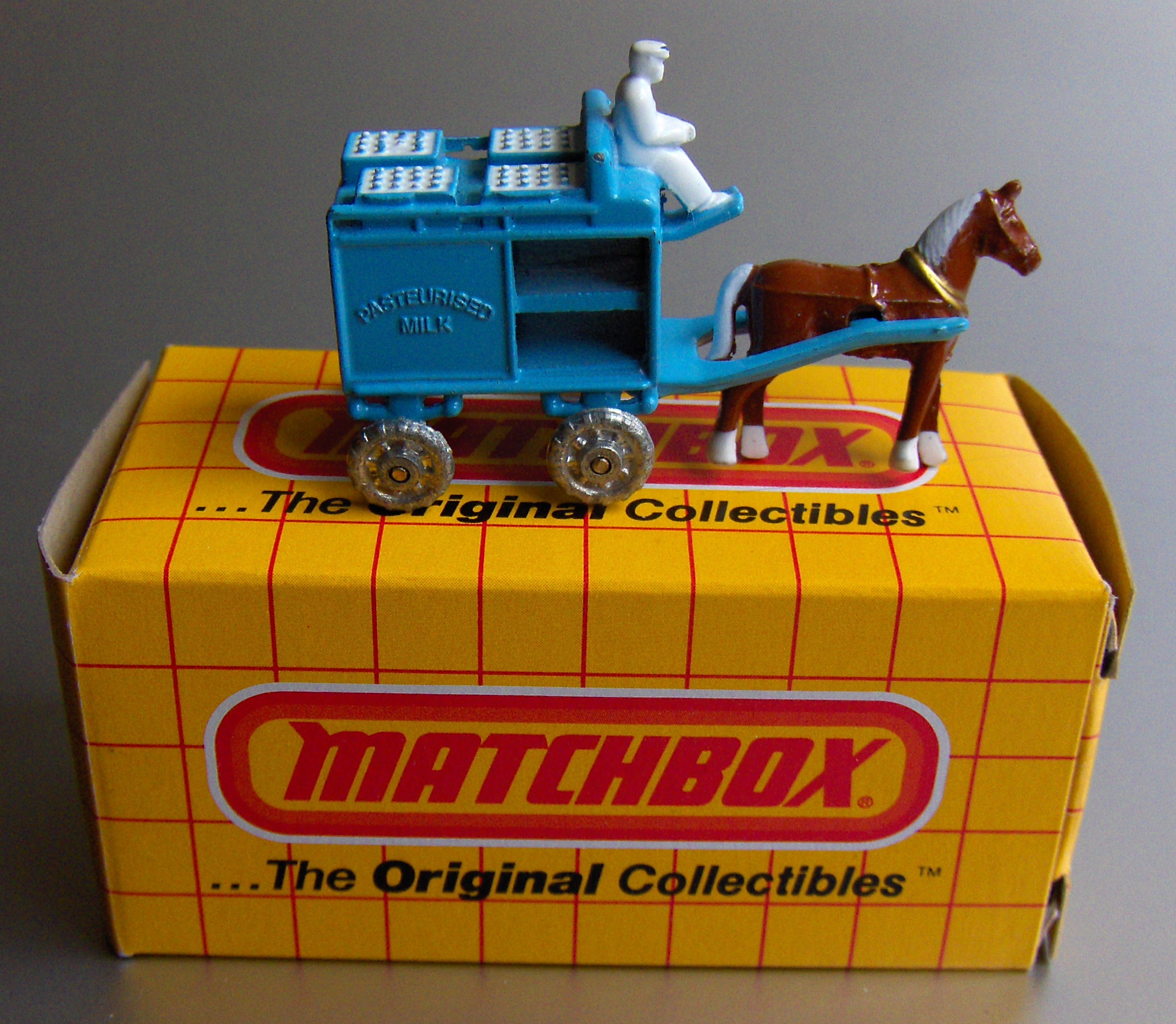
On the backside of these boxes, the Matchbox New Jersey address is mentioned to the left of the barcode and we can also read: "Made in China or Macao" (not Macau as it should rightly have been spelled). I still do not know why the models were distributed like this way. These could have been leftovers from the display promotion for the JC Penney set as described next.
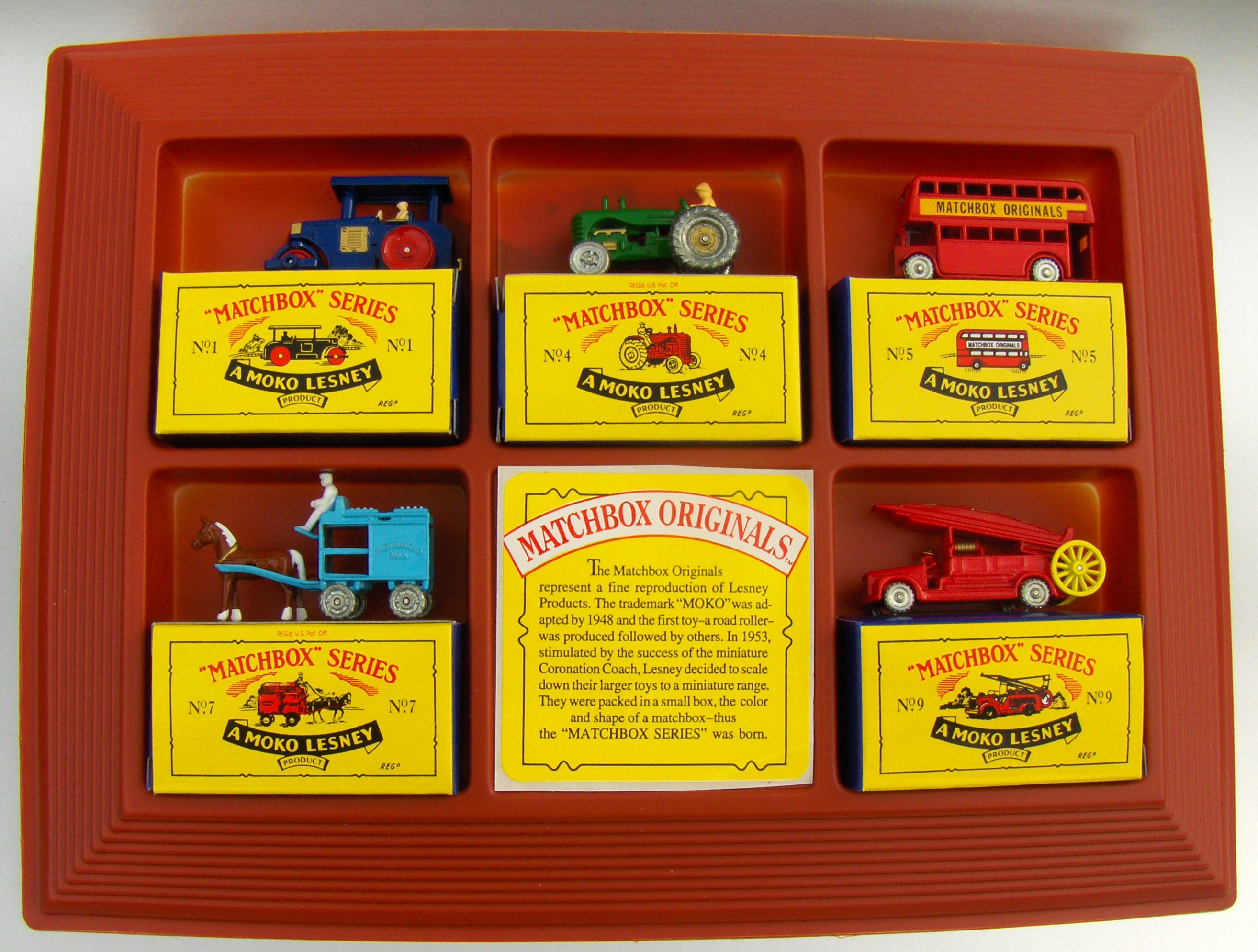
Here again is the same set of five models, all together with a reddish brown vacuum formed plastic display. There is a white instruction paper. There is also a yellow label which you can put on the display in the middle. The repro boxes are flat delivered in the brown cardboard outher carton. The display instructions are included and the original box states: "MATCHBOX, Matchbox Toys U.S.A. Ltd. 141 W. Commercial Ave. Moonachie, N.J. 07074 Cat No. 655-0388, SKU 0000, Item; JCP 5 Pack Originals, MB#11967."
I have the original price sticker from JC Penney still attached to the item. The sales price was USD 9.99, reduced from USD 14.99. I have seen some of these on internet auctions in the past and it is quite a difficult item to find, at least in Europe
A very fragile item so watch out when buying from overseas.
In 1993 five new models were released. Series II comprised:
- MX-106 No.6 Quarry Truck -- blue & grey
- MX-107 No.13 Wreck Truck -- red & yellow
- MX-108 No.19 MGA -- green
- MX-109 No.26 Cement Mixer Truck -- orange & grey
- MX-110 No.32 Jaguar XK 140 -- black
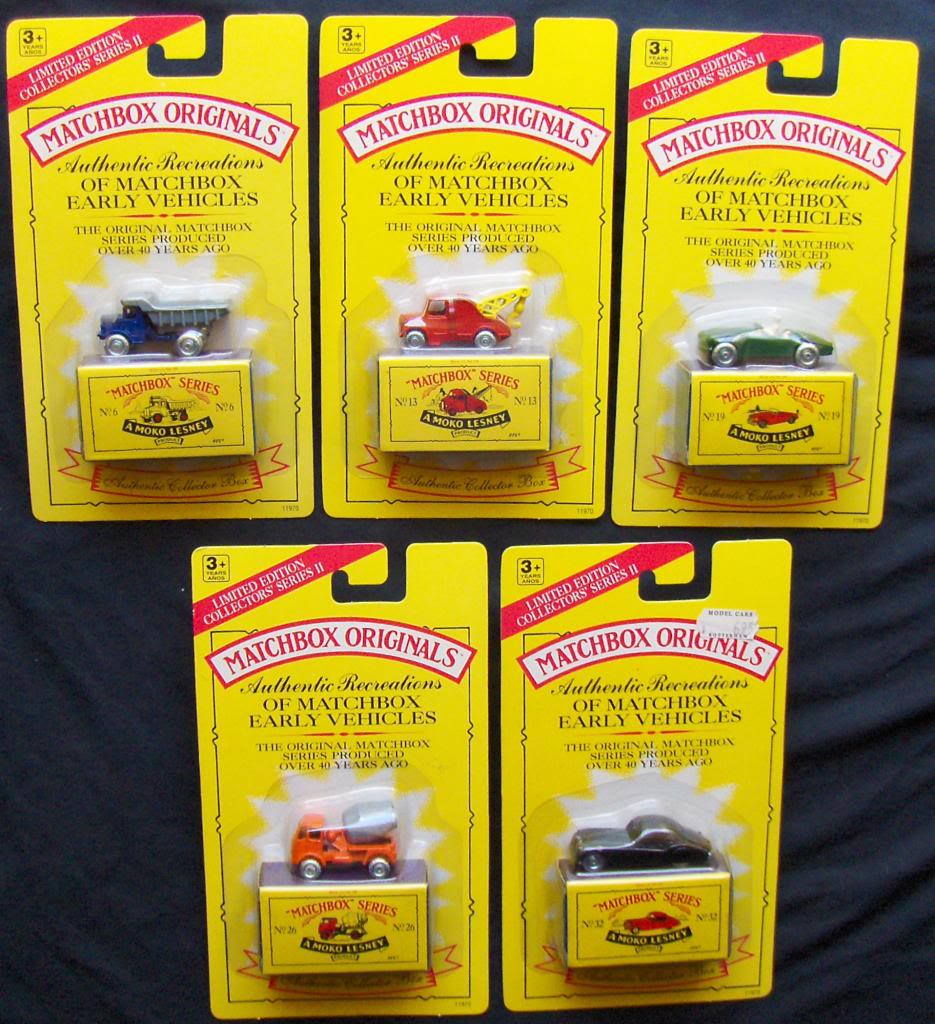
The range was increased in 1994 with the release of Series III;
- MX-111 No.11 Road Tanker -- powder blue
- MX-112 No.12 Land Rover -- green
- MX-113 No.17 Removal Van -- blue
- MX-114 No.18 Caterpillar Bulldozer -- yellow & red
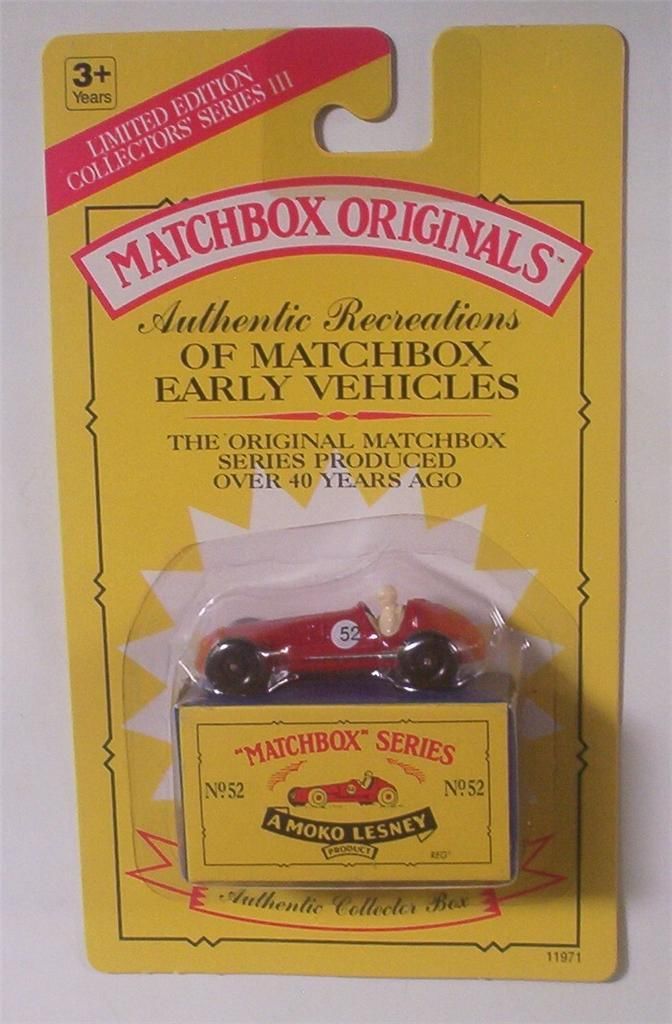
- MX-115 No.52 Maserati Racer -- red
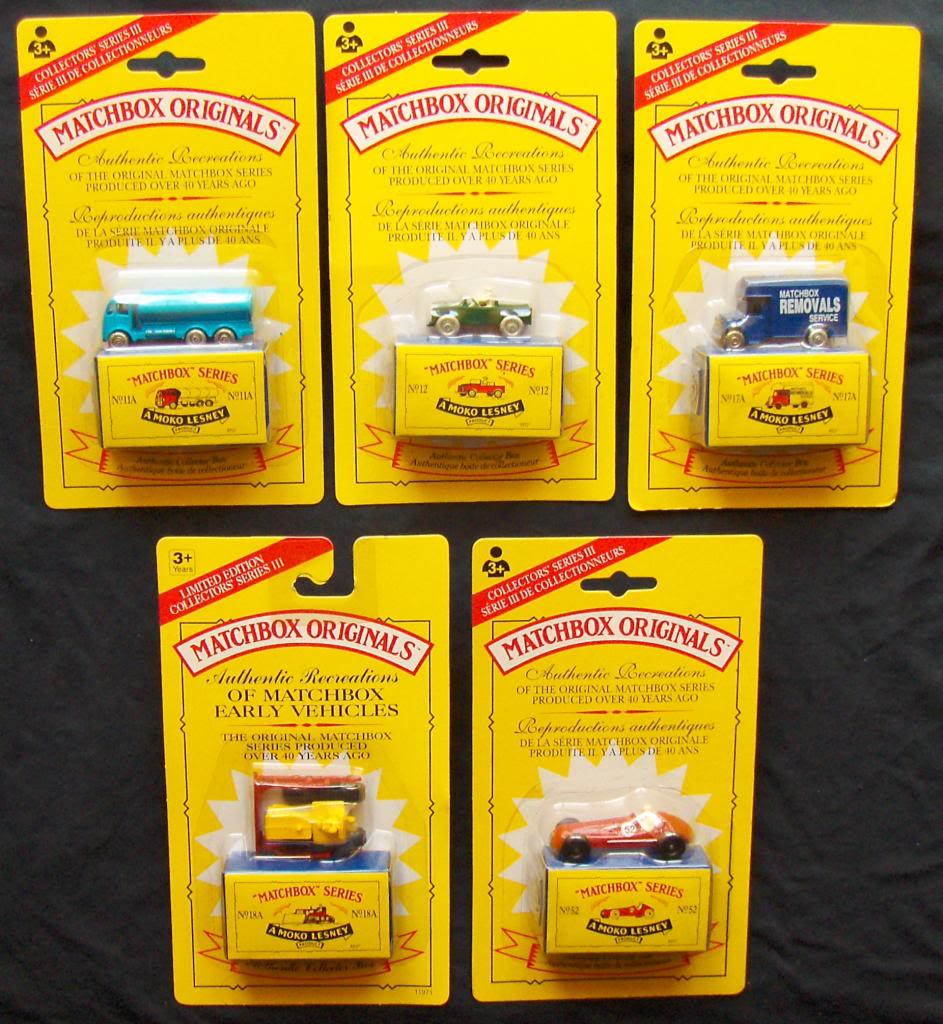
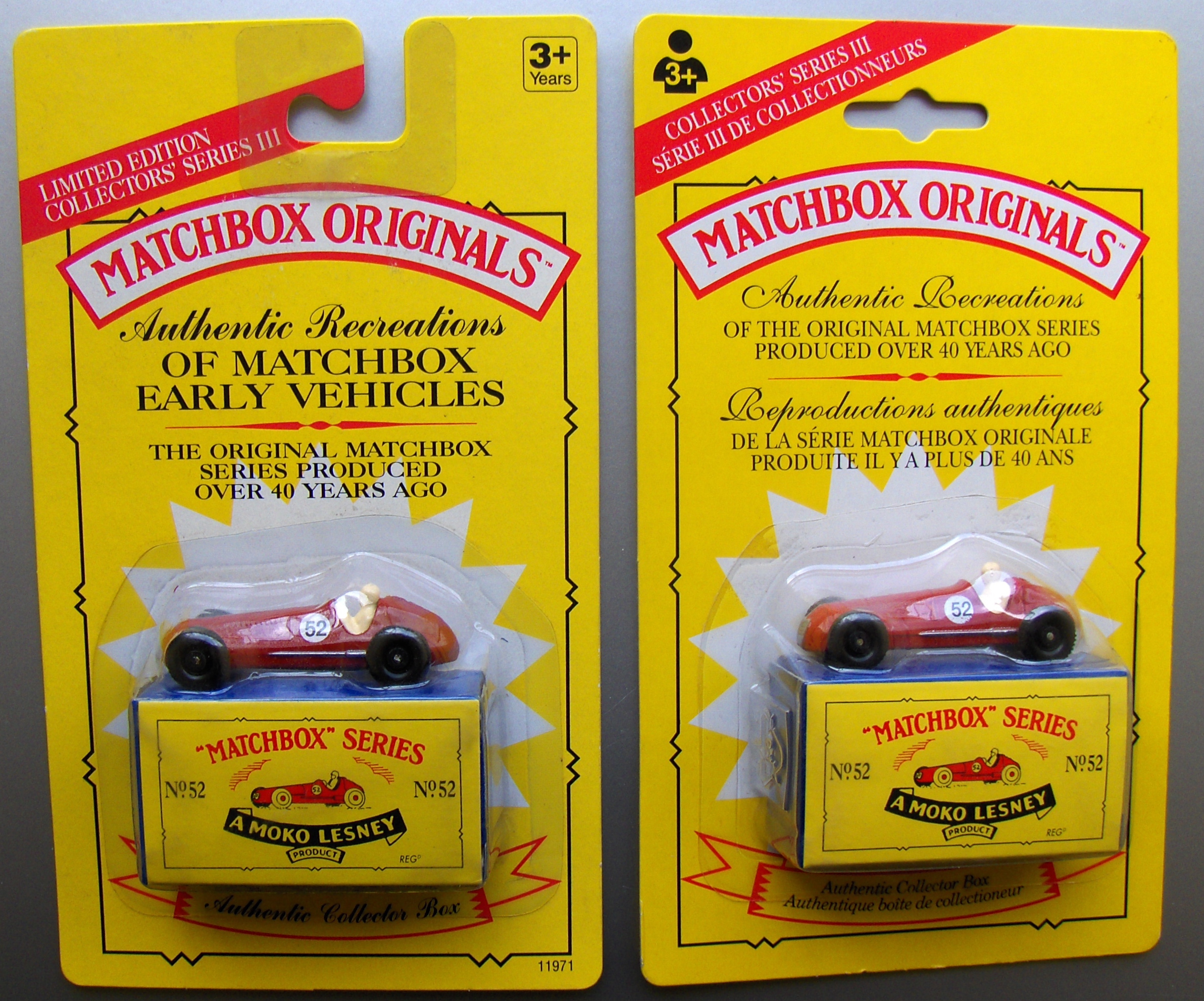
During the period we got this Series III interesting of note is that Matchbox produced a model for the Australian market.
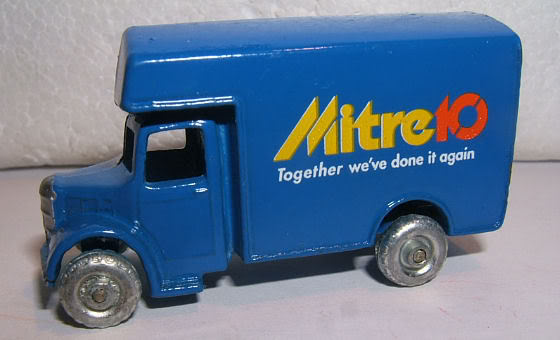
It is the no. 17 Removals Van but in lighter blue and with yellow, orange and white "Mitre 10 Togther we have done it again" advertisement. The blister I have for this model is totally different to my other models in Series III and has no French words on it, but instead a proof of purchase on the backcard.
The layout of the trademark section is also totally different. I haven't seen it for sale for ages but it can eassily be obtained if you call Matchbox dealers like Paul Carr.
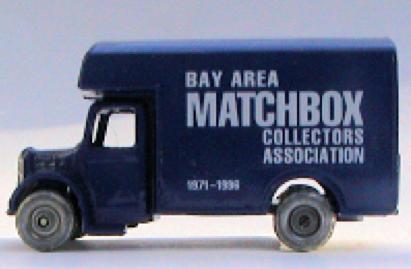
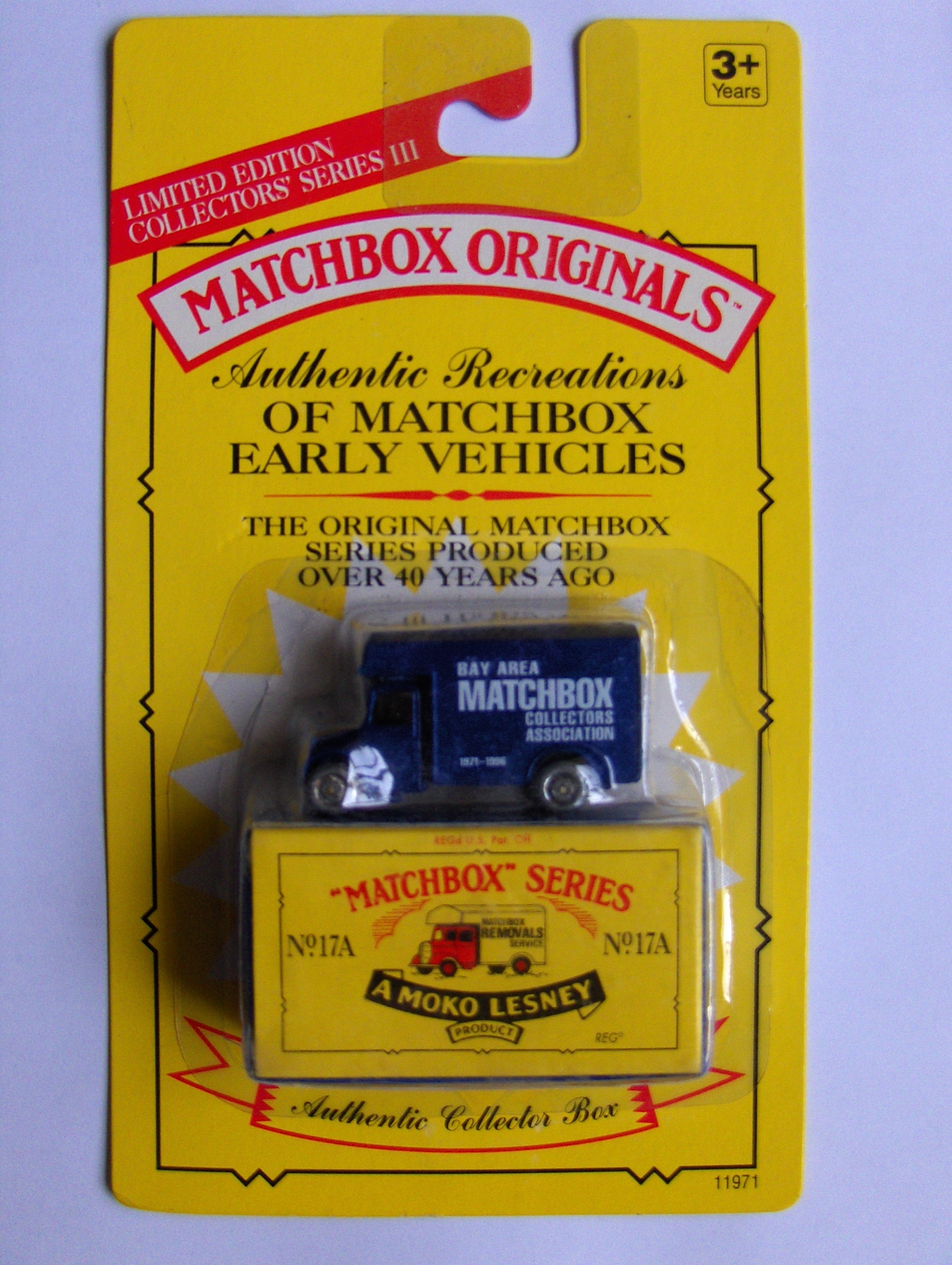
Also the Bay Area Matchbox Collectors Association issued this Removals Van as a code 2 model to celebrate the club's 25th anniversary in 1996.
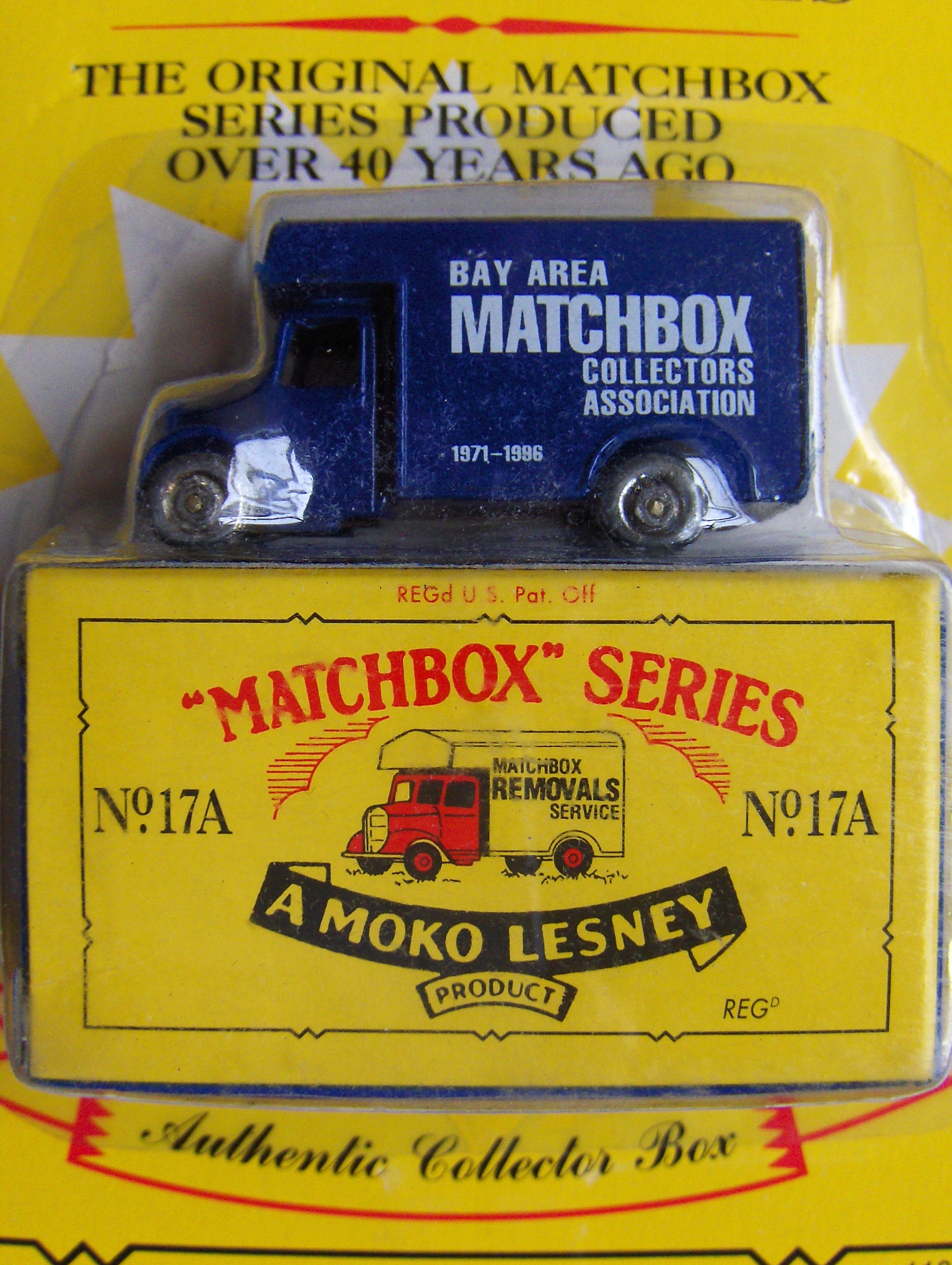
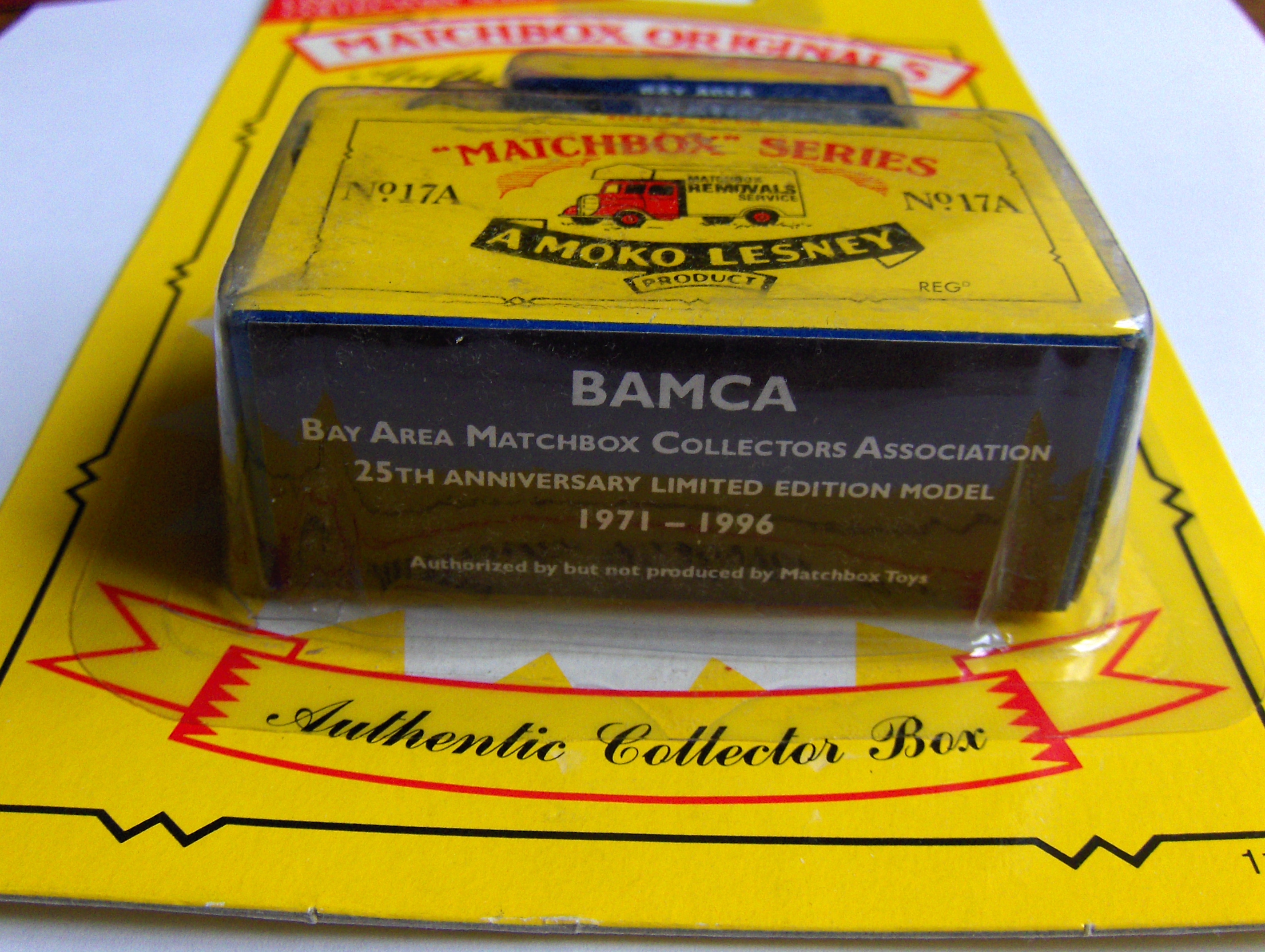
In December 2007, a Belgium Matchbox collector discovered another packagaing for the Maserati from this Series III.
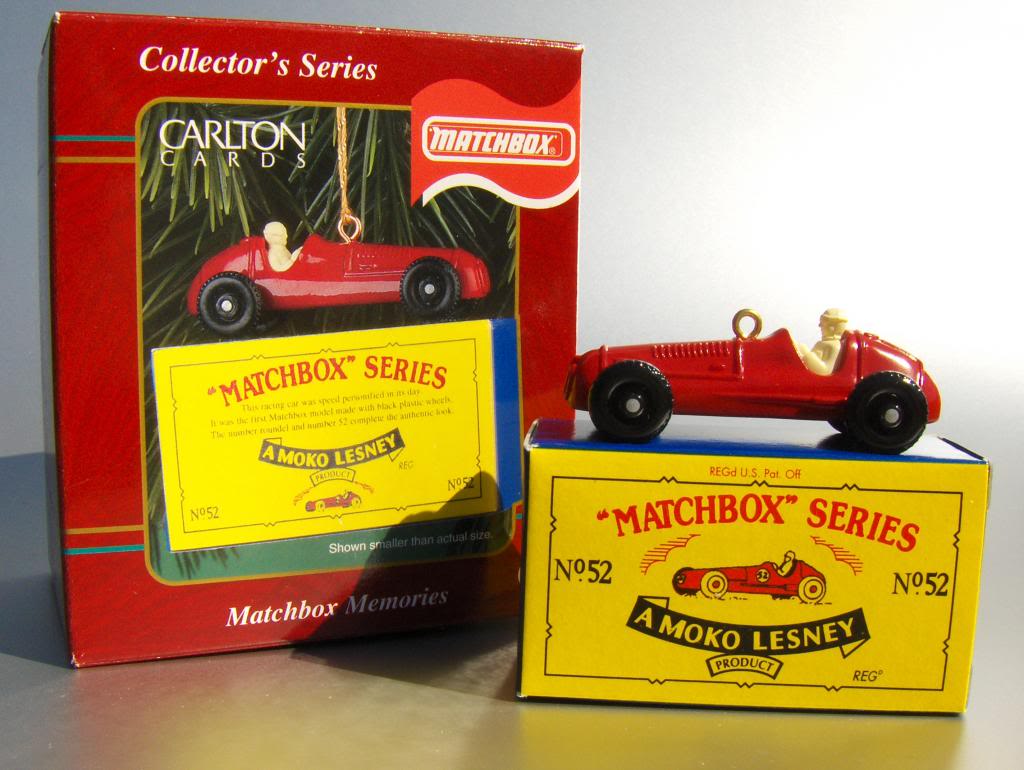
The same red model (with diecast body) was introduced in the Heirloom Collection 10th Anniversary Matchbox Series collection under its number 52. Not much is known about this promotion. If you can supply me more information I would be interested. In which year was this offered during Christmas?
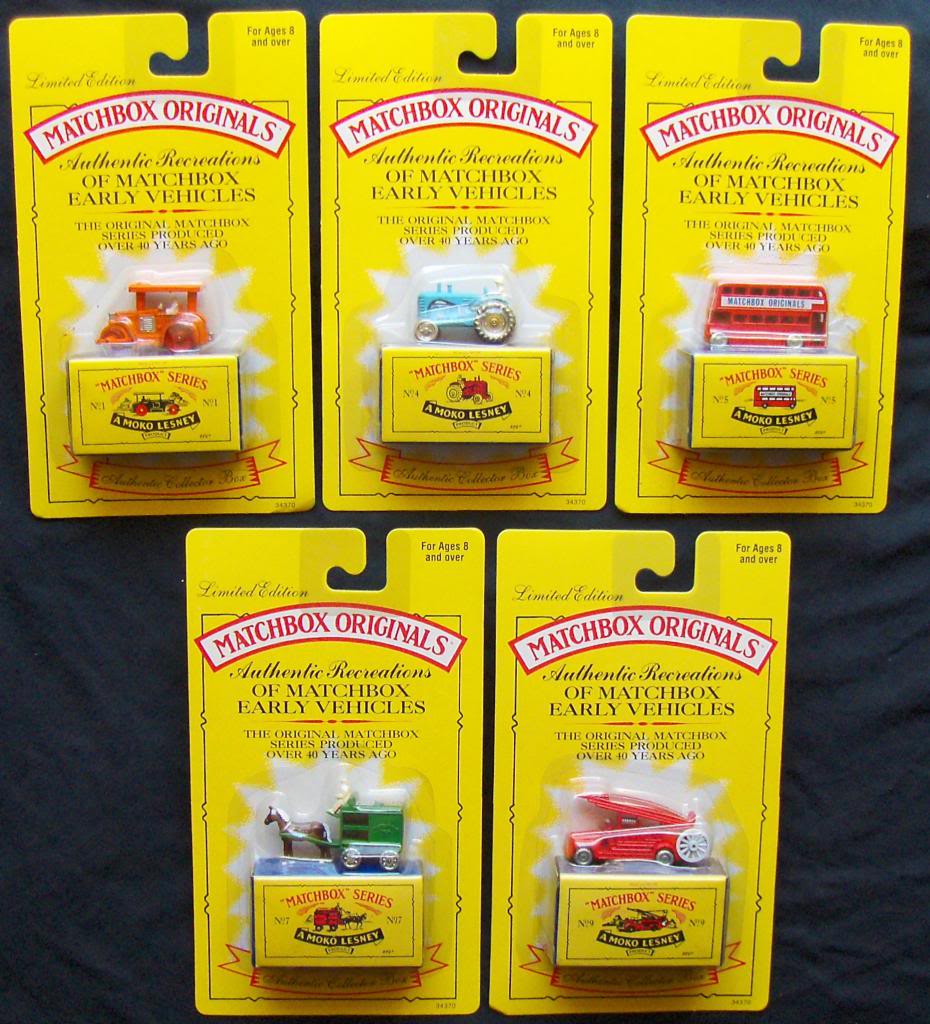
Series IV, the last Matchbox Originals series of five models, was released in 1995 and compised the first five models again but in new colours.
- No.1 Aveling Barford Road Roller -- orange
- No.2 Massey Harris Tractor -- light blue
- No.3 London Bus -- "Matchbox Originals" (white label)
- No.7 Horse-drawn Milk Float -- dark green
- No.9 Dennis F.2 Fire Engine -- red with white escape wheels
Over to the Collectible period three more items were produced.
In the Christmas catalogue of 1995 a four piece set of Matchbox Originals Holiday ornaments was anounched, with the number YCC03-M for the set.
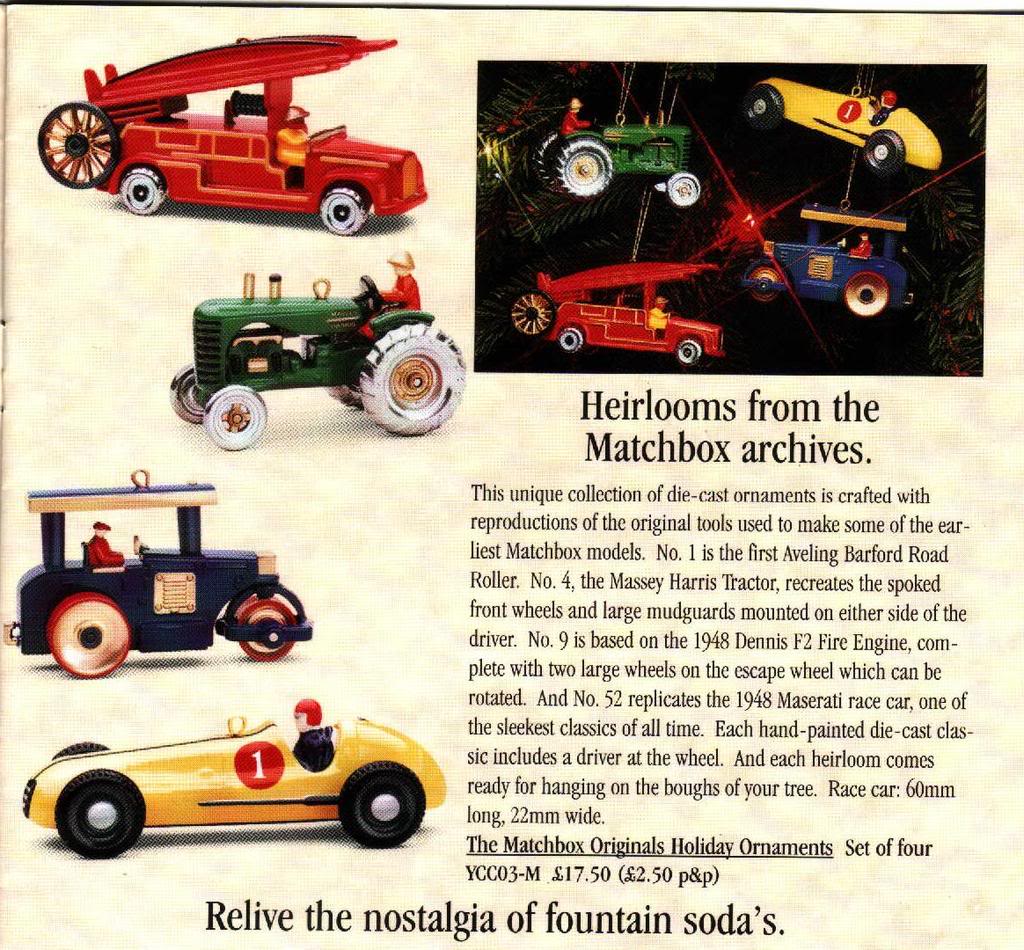
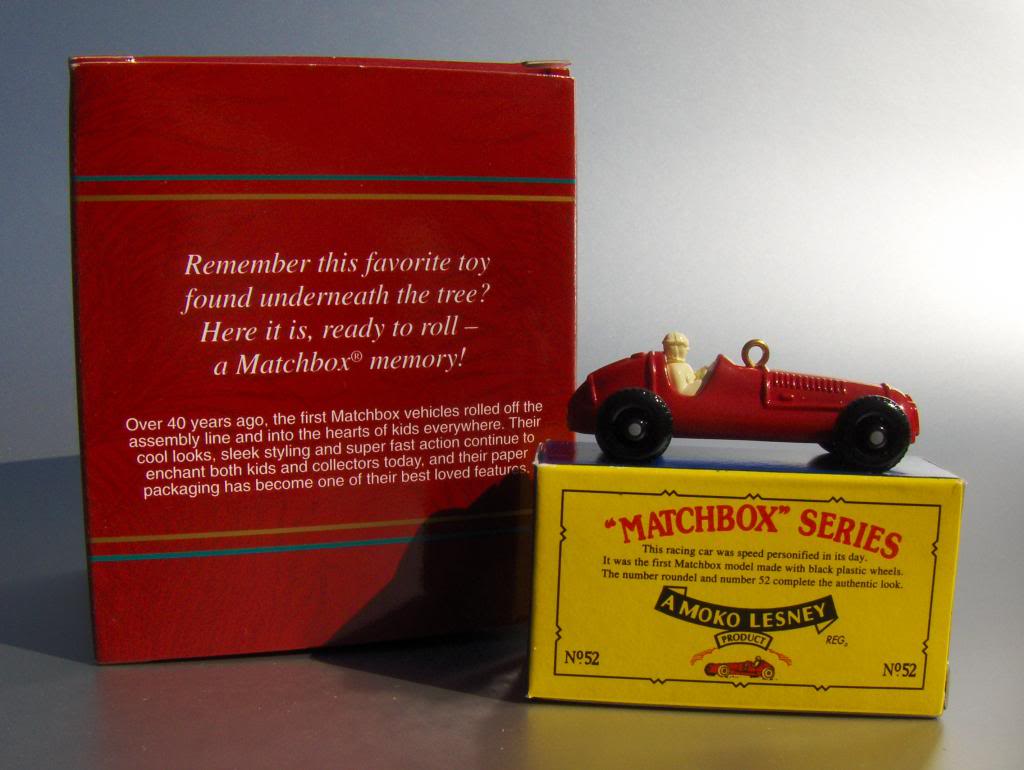
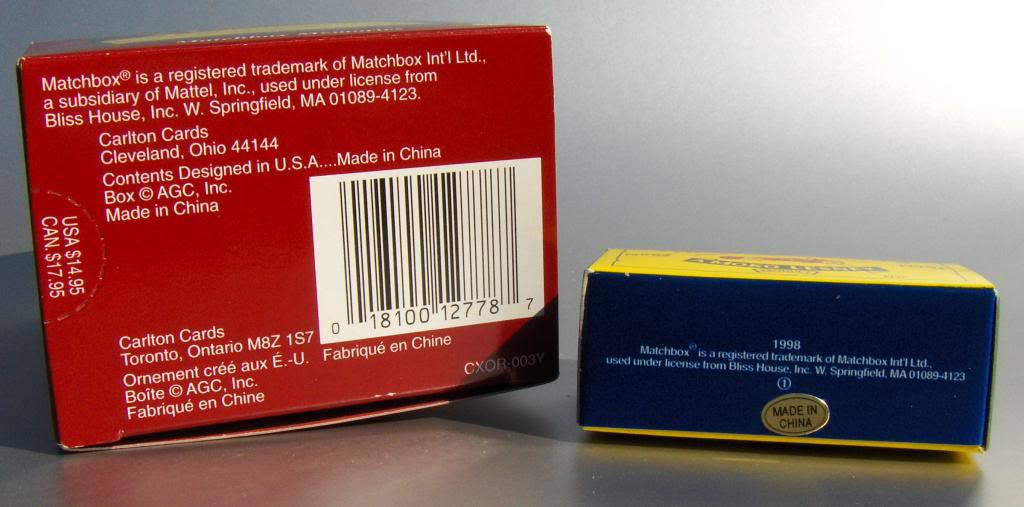
The models were:
- Road Roller -- blue with over the top gold trim
- Fire Escape -- with extra black and gold trim
- Maserati -- yellow with racing no.1. The painting of this model shows far more detail than previous issues (red model from series III)
- Tractor -- green with added gold and black trim (the painting of the driver shows far more detail than previous issues)
It was not till 2000 that we saw the originals used again. This time they were used as a load for one of the Matchbox Collectibles tractor trailers. It's still one of the more expensive trailers if you find one on the net.
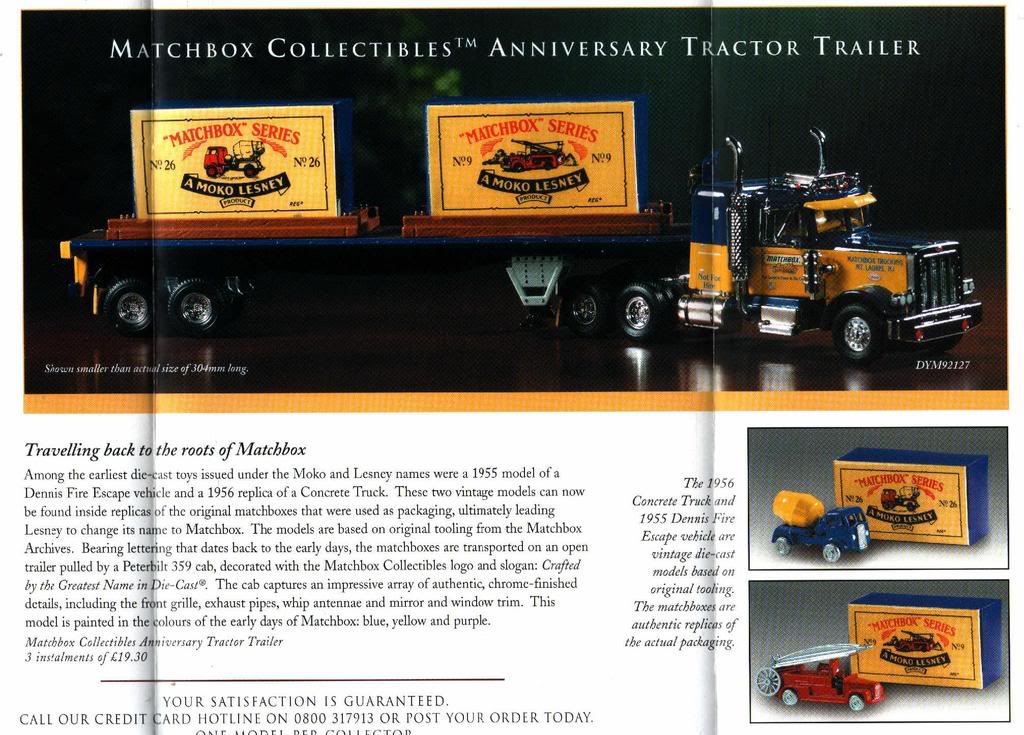
The Peterbilt 359 is yellow and blue and a no.9 Fire Escape with chrome ladder wheel and silver ladder with black and silver coloured driver and a no.26 Cement Mixer in blue with yellow barrel are on top of their retro boxes packed on the flatbed of the truck. The batchcode for this model is 1810 2A and so was produced in July 2000. The box for the truck is dark red and this item should have a certificate. It was marketed as a Dinky Matchbox Exclusive under no. DYM92127.
The castings were last used for the 50th anniversary commerative set containing two of the Original models and three other Matchbox models.
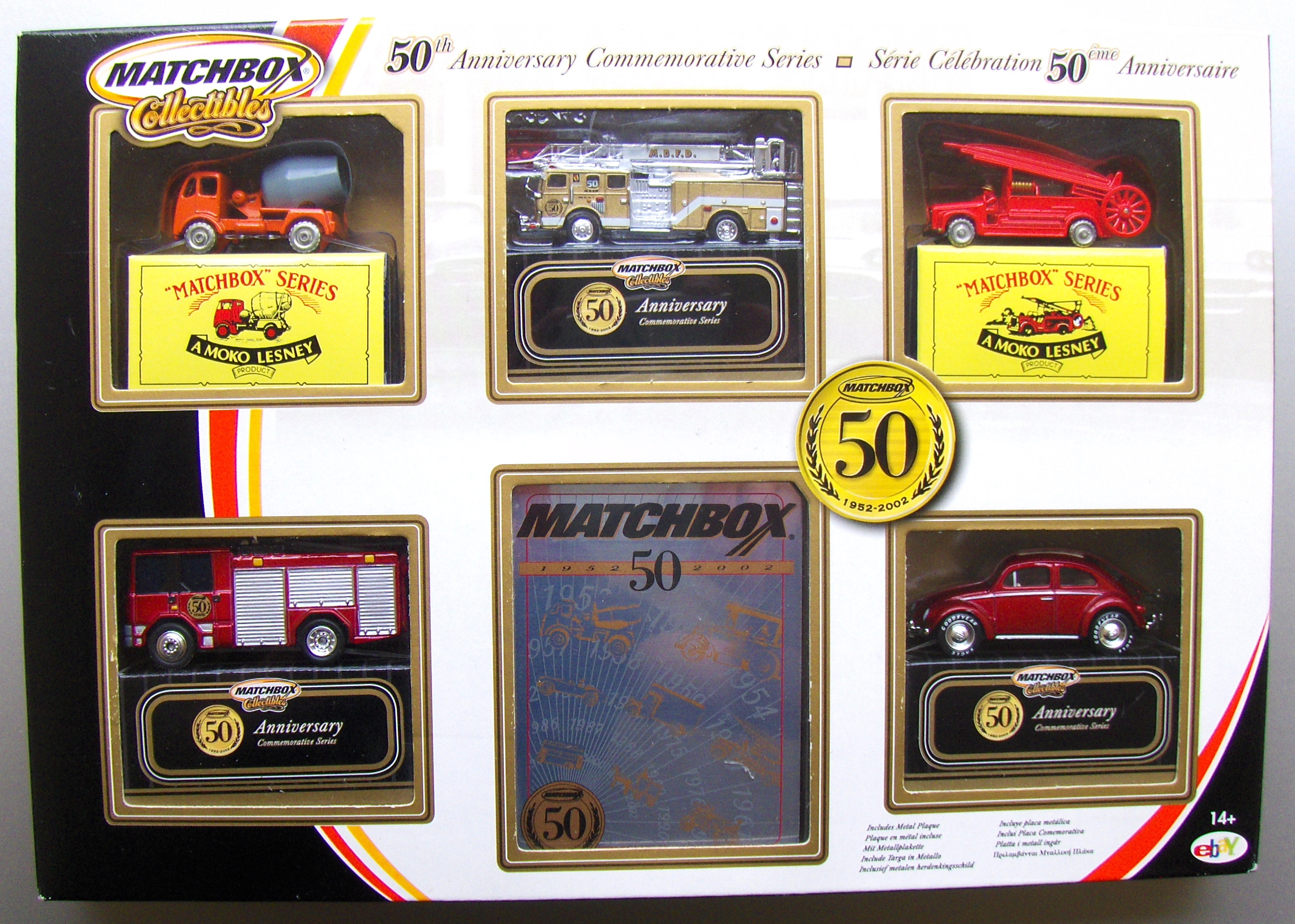
The Originals are the no.26 Cement Mixer and the no.9 Fire Escape. These numbers are not printed on the front of the repro boxes and also some of the trademark text on these repro boxes was deleted. On the Mixer the gold and black 50th Anniversary logo is printed. The Fire Escape has red wheels for the ladder and has the 50th Anniversay logo on the bonnet.
There should be a commerative plaque unique to this set in the box. Interesting of note is that the two Original models are pictured on the backside of the box without the 50th Anniversary logo. The number of the set is 91943-0718 and I have batchnumber 1802 EA printed on the backside of the box, so packed in July 2002.
It was easily available via the Collectible dealers and you can still find these at swapmeets and on the internet.
Points of Sale
The Matchbox Toys marketing managers knew from the outset that the Originals needed shop displays to attract customers and accordingly two items of display material were sadly destined not to see the light of day.
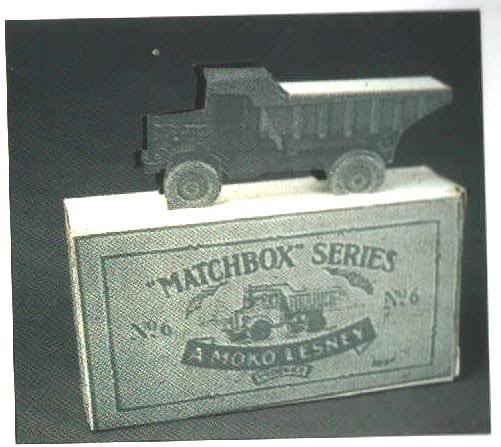
The first was a large carton with a scaled up cut out of the dump truck standing on it, which was developed by the advertising agency and intended for free distribution to retailers. This idea did go beyond the concept stage and indeed only one version in black and white is known to exist.
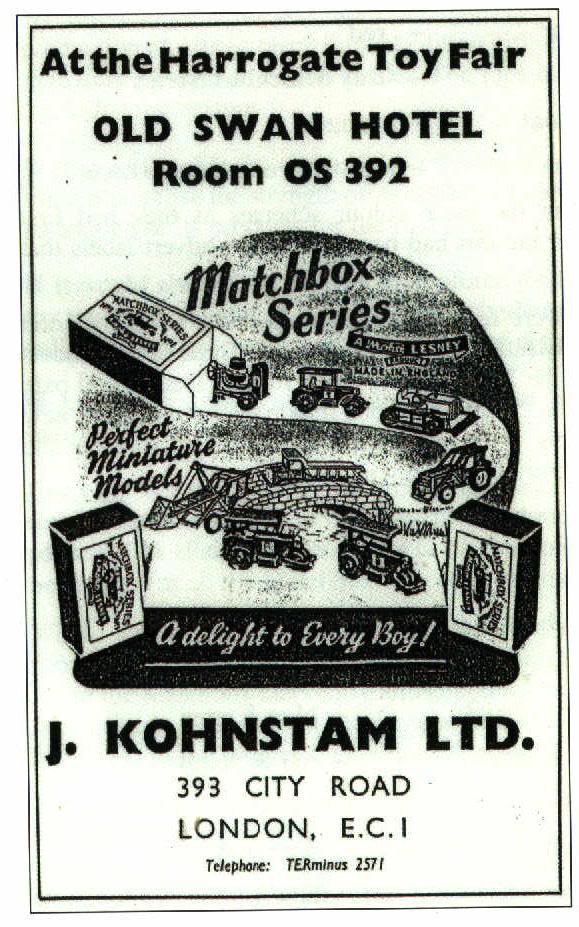
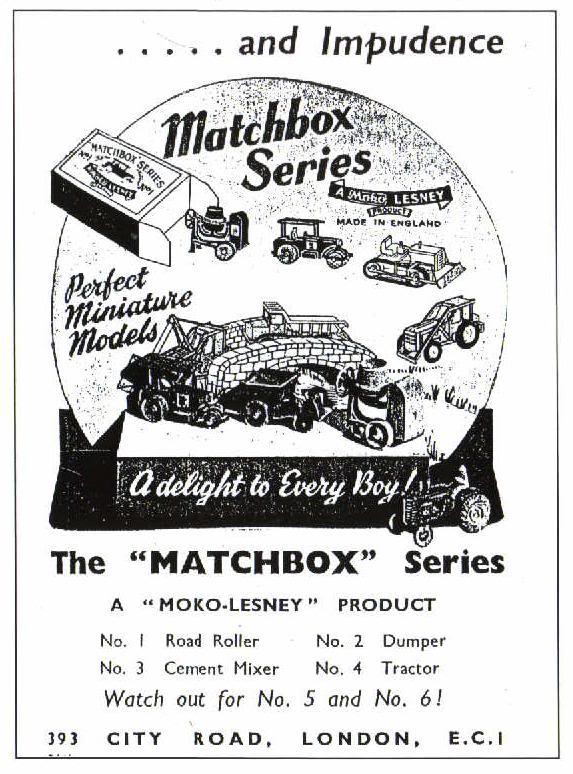
The second is a far greater interest to anyone interested in miniatures as a whole, and indeed is a significant item in the history of Lesney and Matchbox. A press sheet was discovered in the April 1954 copy of Games and Toys magazine announcing the arrival of the "Perfect Miniature Series". As you can see the ad consisted of a display stand illustrating the first six miniatures and it contained a platform just large enough to display a handful of the new arrivals. The unit seemed "perfect" in every way and indeed so impressed were members of the Matchbox Toys sales department that at one stage they were planning to produce the stand in limited quantities and sell them as "collector" item.
One major hurdle was that nobody knew what colour the stand was, as Games and Toys magazine was printed in black and white. Quite by chance and several months later a Matchbox collector with good contacts at Matchbox came across what must be the only surviving original stand in a private collection.
It is definitely the first item of display material that Matchbox produced and most collectors have never even seen one. It stands as a testament to the completeness of the thinking that went into the launch of the miniatures all those years ago. The only criticism that could have been made about the toys was that they did not stand out on the toy shop shelf or window simply because of their size.
This would have been a real concern in the early 1950s as the fledgling company was up against the mighty Dinky Toy range that had more presence and were regularly supported by many types of attractive point of sale materials. Additionally, Lesney Products had only produced five models by this time, which was insignificant when compared to the hundreds of Binns Road competitors.
Although not for sale or even loan this Matchbox collector was allouwed to take some photos for reference and this is one of those unique pictures.
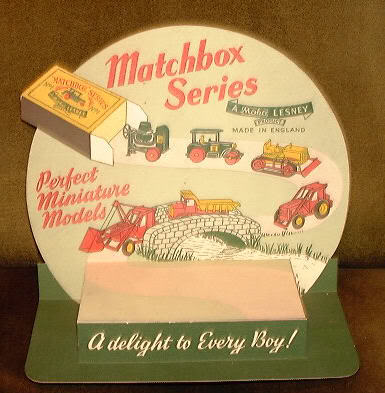
This meant that not only were correct colours finally revealed but the stand could be sized up accurately and in proportion to the original. This was quickly done as the collector who made the picture was one of the founders of MICA and had good contacts with Matchbox. Indeed final artwork was produced but then, disaster! Sales of the Matchbox Originals fell and the prevailing powers that be deemed that no futher funds would be allocated to the range. It was argued that as this was an item to promote the range it should go ahead, and was indeed on the point of production but the "number jockey" held off and the project stopped.
All was not lost however as the artwork and a prototype stand survived. Having found the long lost artwork, the Matchbox International Collectors Association (MICA) set about finding out if it could be used to produce an accurate copy. After a long search, it was handed over to a semi-retired printer and the answere came back "only just!" It transpired that in the last few years the printing industry has moved over to almost entirely to digital technology and that the days of film from conventional artwork are already a thing of the past. However, MICA's allies had a contact with a traditional printer who still used the right equipment, and more importantly some stock of the right card very similar to that of the original.
A final consideration was the finishing of the display and in the end, the printer opted for a semi-matt finish as it was felt that the gloss commonly used today was not accurate to the period of the 1950's.
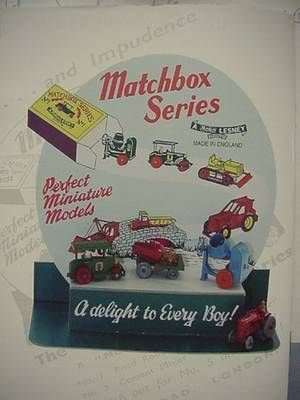
This very attractive display unit which perfectly suits the Matchbox Original series was launched via the MICA magazine (April/May 2005, June/July 2005).
Of course, the No.2 Dump and No.3 Cement Mixer were never reproduced in the Original series so using the original setup as done on the backcover of MICA magazine, Volume 21, no.1 you have to at least buy two old models from the fifties. Interesting of note, I think, is that the setup used in the advertisement on page 276 of MICA magazine Volume 20, no.6 is different and shows two real no.1 Road Rollers with their boxes on the shelf while the picture on page 29 MICA Magazine shows actually the first four models on the shelf. This photo must have been taken later when all four models were ready.
I think I am right about this being the advertisement for the April 1954 Games and Toys Magazine while the other advertisement is the announcement for the Harrogate Fair which I think was in February 1953.
Marcel
See the list of Matchbox Originals models on the BAMCA site here.
THIS PAGE